Agentic GRC
Agentify your Governance, Risk, and Compliance (GRC) processes. Better outcomes from the GRC stack you already have, with no rip-and-replace.
Pre-built micro agents for evidence collection, cross-framework mapping, gap detection, and audit response, or build your own.
Add the custom approval flows, web forms, and case management your team needs. Every change is auditable.
One control library, every framework, including the new AI ones.
The frameworks list grows every year. BlinkOps covers the established ones and the new AI-governance set, with cross-framework mapping built in. Map a control once and let it satisfy every framework it touches. When the next framework lands, the existing evidence already answers most of it.
Cross-framework mapping
One control satisfies many. Answer once, report to SOC 2, ISO, NIST, and the rest without duplicating evidence.
Built for AI governance
ISO 42001, NIST AI RMF, EU AI Act covered alongside the traditional set, so AI controls do not become a separate program.
Evidence from your real systems
Pulled from the systems of record, not staged. Citation-ready for any auditor request.


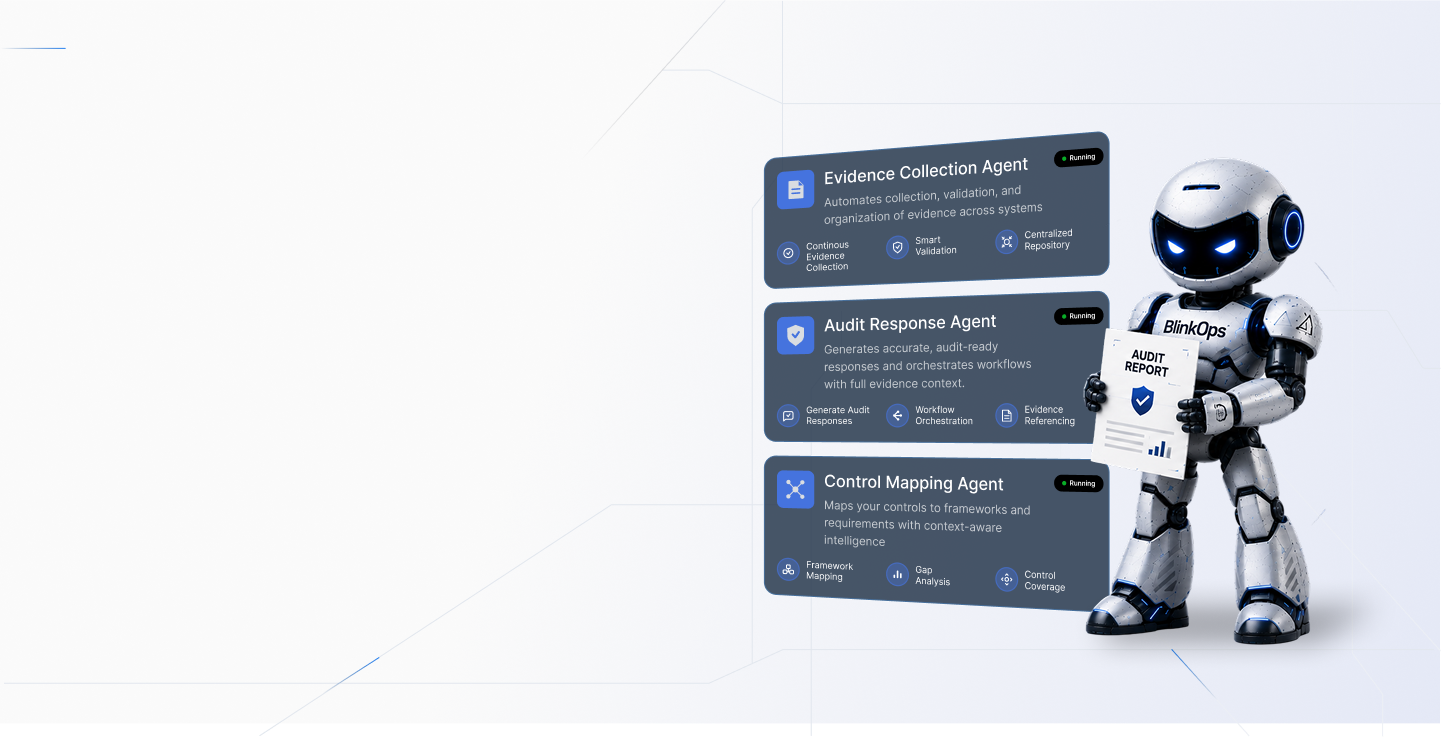
Featuring the most commonly used agents for GRC
Each agent has a focused role, a knowledge base specific to your control library, and a tightly scoped set of abilities. They collect, they map, they assess, and they answer the auditor.
Evidence Agent
Collects evidence from your systems, on its own
Pulls control evidence directly from connected systems on a schedule. Vaulted, timestamped, and citable. No screenshots, no manual upload, no Sharepoint folder full of PDFs.
Scheduled collection from your systems
Vaulted and timestamped
Citation-ready, no manual uploads
Control Mapping Agent
One control, every framework
Maps each control and its evidence to every framework it satisfies. SOC 2, ISO 27001, NIST CSF, PCI, HIPAA, FedRAMP, ISO 42001, the EU AI Act. Answer once, report everywhere.
One-to-many framework mapping
Covers traditional and AI-governance frameworks
Re-uses evidence across reports
GAP Agent
Surfaces failing controls in real time
Continuously assesses control state against policy. Flags failing or stale controls, routes a case to the owner with context, and tracks remediation through to verified close.
Continuous control assessment
Owner-routed cases with context
Day-of-failure detection
Audit Response Agent
Answers auditors from the source
Assembles evidence packages on request, grounded in the control library and the evidence vault. Answers auditor questions with citations and proof, so the back-and-forth ends faster.
Evidence packaging on demand
Citation-grounded answers
Cuts auditor back-and-forth

Your evidence cannot keep pace with your frameworks.
Controls in scope grow with every new framework. ISO 42001 lands. The EU AI Act lands. DORA and NIS2 land. Manual evidence collection stays at the same capacity, so the share of controls with current, defensible evidence shrinks every year. Audits paper over the gap. Adversaries do not.

From control event to audit-ready package.
Agentic workflows that collect evidence on cadence, map it across every framework it satisfies, surface gaps the day they appear, and assemble audit packages on request. Continuous, in your tools, with a full audit trail.

Control event in


Collect and map


Owner sign-off
Logged
Audit-ready
Comply continuously. Audit any day.
Evidence stays current
Refreshed from systems, not screenshots.
Map once, report many
One control answers every framework it satisfies.
Gaps surface in real time
The day they happen, not the day the auditor finds them.
Audit-ready every day
Packages assembled on demand, with citations.
One platform. The building blocks behind every control.
Agentic GRC is not a single agent. It is dashboards, tables, case management, agents, workflows, and the channels your team already works in, packed into one end-to-end solution.
Control library, framework mappings, evidence vault, exception register, and audit history.

Every gap, exception, and audit request tracked as a case from open to closed, with full history.
Collect evidence on schedule, map controls across frameworks, assess state, and answer auditors.
Deterministic execution. Pull from connected systems, vault, route, and log.
Control owners submit attestations and exception requests in one portal, with the right context.
Owners get nudged in Slack or Teams to confirm or update an attestation, in thread.
IdP, cloud, HRIS, SaaS, SIEM, and ticketing connected as evidence sources through one engine.

90 days vs always current.
Same audit. Two operating models. The difference is whether your program runs on a calendar or in real time.
Quarterly scramble
Email owners → Chase screenshots → Re-collect
Email goes out to control owners. People dig through systems for screenshots. Same evidence collected again for each framework. The auditor arrives, the program freezes, everything else stops.
→
~90 days of audit prep
Continuous compliance with Blink
Pull from systems → Map to frameworks → Vault
Evidence refreshes itself on cadence, mapped across every framework it satisfies. Gaps surface the day they happen. The auditor's package is one click, not a project.
→
Audit-ready every day
vs