.webp)
.webp)

AI SOC for Security Leaders
How to Reduce Risk, Match Attacker Speed, and Cut Tool Sprawl

How to Reduce Risk, Match Attacker Speed, and Cut Tool Sprawl


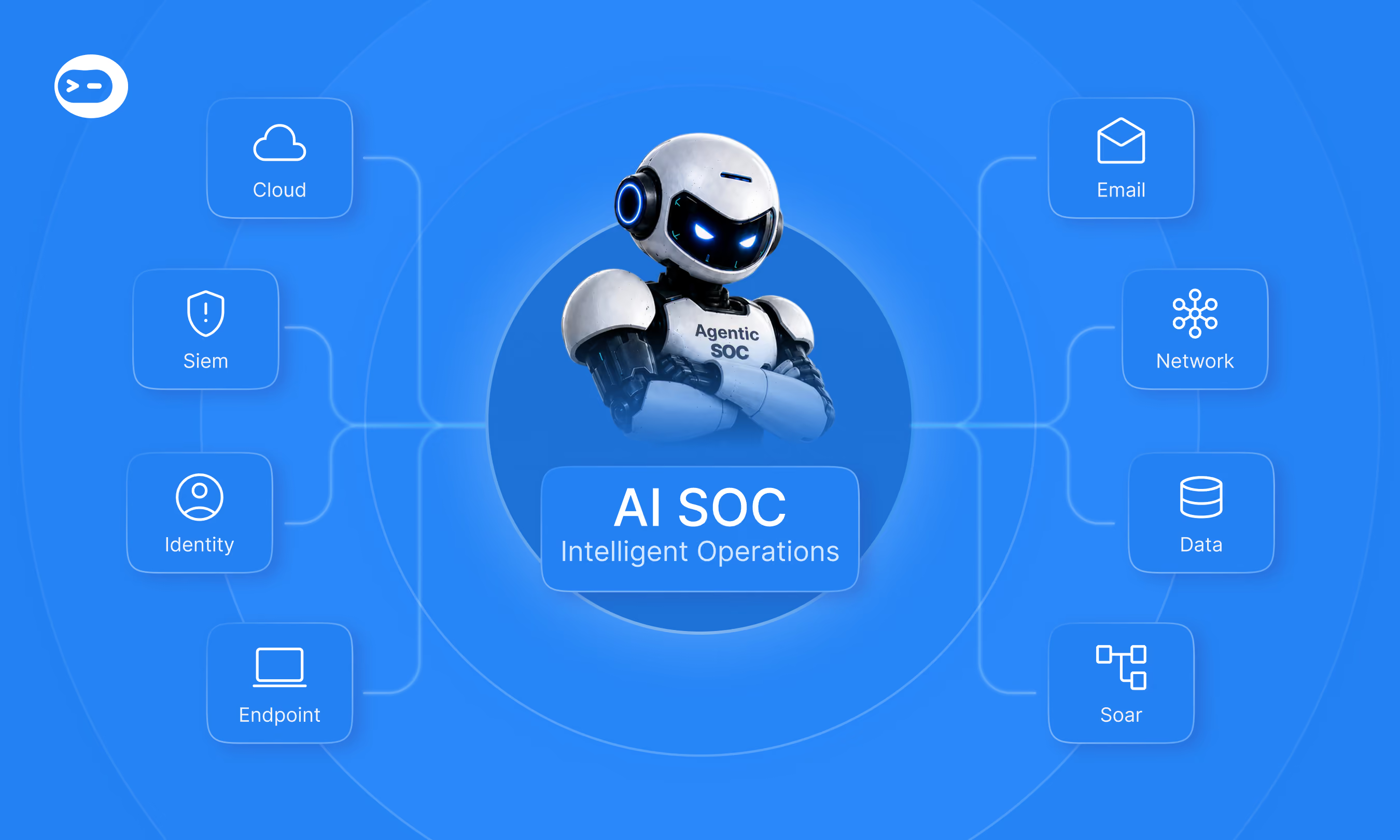
AI SOC, also called Agentic SOC, is a risk-reduction decision, not a tooling decision. Evaluated correctly, it can reduce dwell time, cut alert fatigue, free analysts for higher-value work, and help consolidate the security stack. Evaluated poorly, it becomes another tool in the pile, adding opaque decision-making that security leaders cannot easily audit or trust.
That is why we created the AI SOC for Security Leaders guide: a free report covering the three questions that matter most when evaluating AI SOC vendors, plus the frameworks leaders can use to assess any platform, regardless of which vendor they choose.
Every security investment is a risk trade. You reduce some risks and you take on others. The honest evaluation of AI SOC starts with both columns.
77% of organizations are already using AI in security operations, and 68% of CISOs name it a top investment priority. The money is moving. The results are uneven, mostly because teams are deploying AI on top of broken foundations and measuring the wrong things.
The implementation patterns, not the technology, determine which column wins. More on those below.
Attackers adopted AI faster than defenders. Phishing emails are now drafted by LLMs and personalized at scale. Vulnerability discovery is partially automated. Evasion techniques are tested against open-source detection tooling before deployment. Initial access brokers use AI to triage which compromised credentials are worth selling.
This is not a future problem. It is the current operating environment.
A SOC team running human-speed processes against machine-speed attacks loses on volume. Analysts can investigate only a fraction of daily alerts with real depth. An attacker running an AI-augmented campaign can generate phishing variants at machine speed all morning. The case for AI in defense is about matching the speed and scale of the other side. Three areas where this matters most:
Detection speed at scale. AI-powered triage catches the signal in the noise faster than any tuned correlation rule. When attackers generate polymorphic payloads, your detections cannot be hand-tuned every week. You need detections that learn.
Investigation depth at scale. Most teams investigate the high-severity alerts and rubber-stamp the rest. AI lets you investigate everything, even the low-severity alerts. That is where you find the patient attackers who deliberately stay below severity thresholds.
Response speed where it makes sense. For low-blast-radius actions on low-stakes assets, AI-driven response, governed by guardrails and auditable decision logs, closes the window between detection and containment. For high-blast-radius actions, you keep humans in the loop. The point is to match speed to risk, not to automate everything.
The leaders who get this right enable their teams to operate at the same tempo as the attackers. The leaders who do not are setting their teams up to lose, regardless of how good the analysts are individually.
Most security organizations run 30 to 80 tools: SIEM, SOAR, EDR, UEBA, TIP, NDR, vulnerability scanners, CASB, DLP, IAM, PAM, ITSM, ticketing, and more. Each one was bought to solve a real problem. Each one came with integrations to maintain, dashboards to monitor, and a vendor to manage. The aggregate cost in budget and operational overhead is enormous.
AI SOC is a chance to reverse the sprawl, but only if you treat it that way.
The wrong way: buy an AI SOC platform, plug it into your existing 40 tools, and now you have 41 tools. Same dashboards, same integrations, plus a new layer that interprets what the others produce.
The right way: use AI SOC as the consolidation layer that replaces multiple existing tools or makes them redundant. The platforms worth evaluating do at least one of three things:
For a security leader, the question to ask any vendor is direct: “What does this replace?” If the answer is “nothing, it sits on top,” that is a tool added, not a tool consolidated. If the answer is “SOAR, parts of the SIEM workflow, and three of your enrichment platforms,” that is a consolidation play worth funding.
The tool sprawl angle also matters for the budget conversation with the CFO. AI SOC budget that comes out of net new spend is one conversation. AI SOC budget that retires existing line items is a much easier conversation.
Three frameworks your team should use to evaluate AI SOC platforms. You do not need to run them yourself. You need to ask whether they were used.
Scores AI SOC platforms on response capability across six planes (Identity, Network, Endpoint, Cloud, SaaS, General). Two scoring modes: Evaluator (vendor comparison) and Builder (deployment planning for your specific environment). Co-authored on cybersec-automation.com with Andrei Cotaie and Cristian Miron. Free to use.
The most useful output for a security leader: the gap between coverage rate and automation depth. A platform with 80% coverage and 5% automation is broad but shallow. A platform with 60% coverage and 30% automation does fewer things but actually does them. Different profiles for different operating models.
Five levels of agent autonomy (L1 Operator through L5 Observer), from a University of Washington paper. Map autonomy levels to workflows: triage at L4 to L5, investigation at L3, threat hunting at L2 to L3, response actions at L1 to L2. Each level must be paired with appropriate guardrails, human oversight, and auditable reasoning. The mistake to avoid is buying a vendor that offers L4 to L5 across the board and deploying it that way. Match autonomy to risk.
Maps metrics to incident response phases (Preparation, Identification, Containment, Eradication, Recovery, Lessons Learned) so you measure across the lifecycle, not just the noisy parts. Published on cybersec-automation.com.
The headline metrics from PICERL that matter most:
If your team cannot report these, the AI SOC investment is not being measured properly. Push back.
The patterns below are the difference between an AI SOC that works and one that creates incidents you did not have before:
If your team’s rollout plan is missing these, that is where to push. These are not optional best practices. They are the controls that separate a working AI SOC from a liability.
Use these six decision factors when evaluating any AI SOC vendor:
The AI SOC decision is a risk decision, a defense capability decision, and a tool consolidation decision, in that order.
Reduce risk, do not just shift it. AI SOC done well reduces dwell time and alert fatigue while freeing analysts for higher-value work. Done badly, it creates opaque decisions, supply chain dependencies, and automation runaway. The implementation patterns are the difference. Demand them.
Match the speed of the other side. Attackers operate at machine speed. A SOC operating at human speed is no longer competitive. AI in defense is not a feature. It is a baseline capability now. Your team needs the tooling and the autonomy model to keep pace.
Make this a consolidation play, not another tool. Ask every vendor what their platform replaces. If the answer is “nothing,” reconsider. If the answer is “SOAR, parts of the SIEM workflow, and your enrichment stack,” that is a real budget conversation.
An AI SOC (sometimes called Agentic SOC) is a security operations center where AI agents handle triage, investigation, and response tasks that previously required human analysts. These agents operate with guardrails, auditable reasoning, and human-in-the-loop controls so your team decides when the machine stops and the human starts. It does not replace analysts. It matches the speed and scale of AI-powered attackers so your team can operate at the same tempo.
Traditional SOAR relies on rigid, pre-built playbooks that break when conditions change. AI SOC uses reasoning agents that adapt to new patterns, correlate across tools, and investigate without requiring a human to script every step. The best AI SOC platforms replace SOAR entirely.
The top risks are opaque decision-making (if agent reasoning is not logged), automation runaway (if guardrails are not enforced as code), and supply chain dependencies on model providers. All three are controllable with the right implementation patterns: shadow mode, double-layer governance, and a formal agent supervisor role.
Use the PICERL Index to measure across the full incident response lifecycle. The four metrics that matter most: Mean Time to Triage, auto-close-to-reversal ratio, escalation accuracy, and model drift over time. If your team cannot report these, the investment is not being measured properly.
It depends on how you deploy it. If the platform replaces SOAR, reduces SIEM dependency for triage, and compresses your detection console count, it is a consolidation play. If it sits on top of your existing stack with no tool retirement, it is tool number 41.
[1] TechRadar. Businesses are finally taking action to crack down on AI security risks.
[2] ITPro. CISOs are keen on agentic AI, but they’re not going all in yet.
[3] Stojkovski, F., Cotaie, A., Miron, C., 2026. We built a framework to score AI SOC response capabilities (ARMM).
[4] Stojkovski, F., 2026. The SOC Autonomy Trap.
[5] Feng, K.J.K., McDonald, D.W., Zhang, A.X., University of Washington, 2025. Levels of Autonomy for AI Agents.
[6] Stojkovski, F.. Measuring ROI of AI agents in security operations: PICERL Index.
Blink is secure, decentralized, and cloud-native. Get modern cloud and security operations today.