.webp)
.webp)

What is AI SOC? A Complete Guide
Learn what AI SOCs are, how they work, and the benefits and challenges of using them.

Learn what AI SOCs are, how they work, and the benefits and challenges of using them.


AI-Driven SOC (Security Operations Center) is a modern approach to cybersecurity that uses artificial intelligence and machine learning to automate and enhance security operations . Traditional SOCs often rely on manual processes and human SOC analysts to monitor and respond to security alerts. In contrast, AI-Driven SOC integrates intelligent systems that can analyze vast amounts of security data in real-time, enabling faster detection and response to cyber threats.
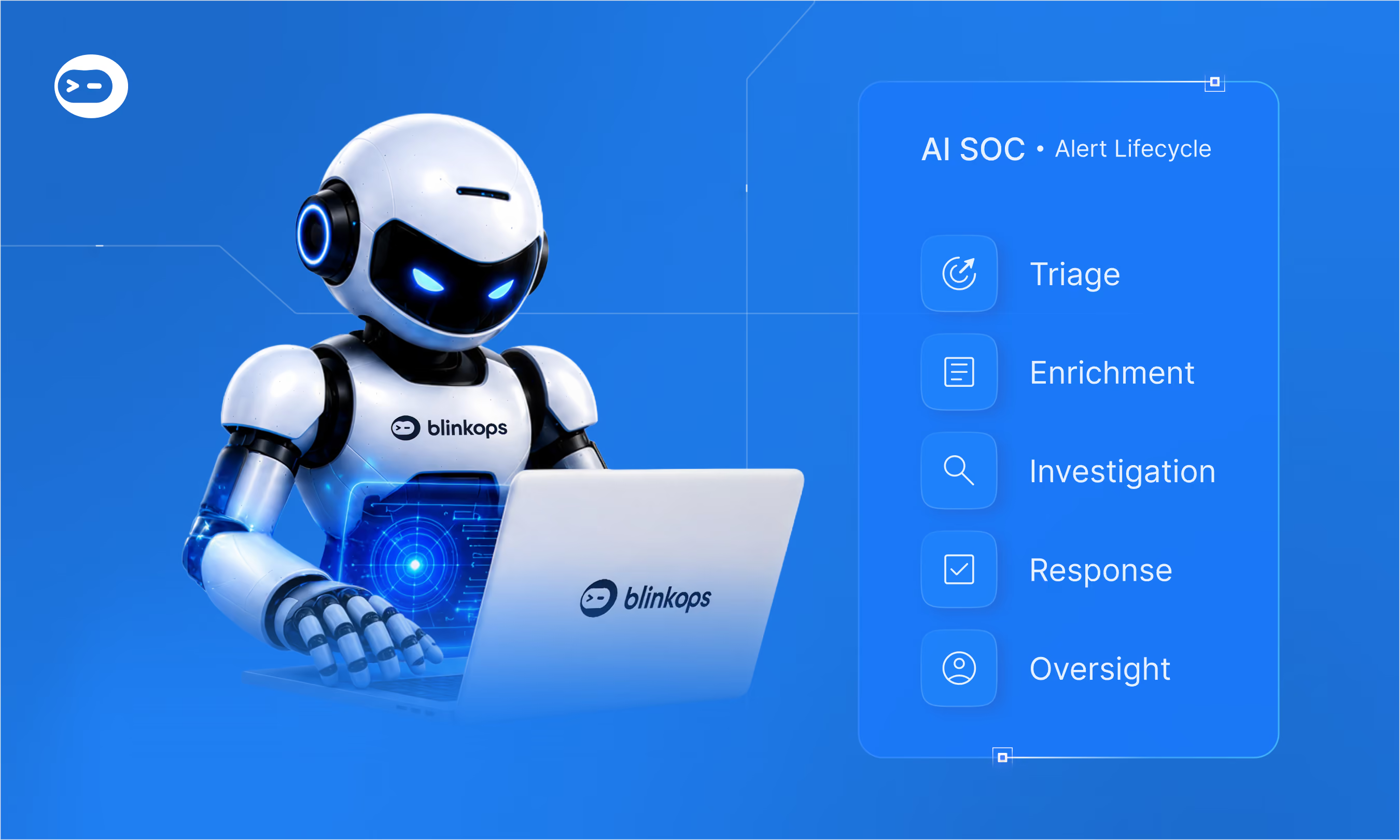
It helps to separate AI in the SOC from a true AI SOC. Bolting AI onto an existing tool, a smarter alert filter here or a summarization feature there, delivers incremental improvement to individual tasks. A purpose-built AI SOC is different: it embeds agents across the full alert lifecycle, from enrichment and investigation through decision and response, and it does so under human-defined control. The question is not whether a single step gets faster, but whether the entire path from raw alert to resolution runs under governed, auditable workflows that a security leader can trust.
This is where the market term meets an operating model. When teams ask what is AI SOC, they are usually describing the outcome BlinkOps delivers as Agentic SOC: an ai driven security operations platform where reasoning and deterministic agents work the alert lifecycle together, with humans setting the level of autonomy and staying in the loop on the decisions that matter.
A traditional SOC and an AI SOC pursue the same goal, protecting the organization, but they distribute the work between people and machines very differently. In a traditional SOC, analysts carry the manual load of triaging, investigating, and responding to alerts, which does not scale as alert volume climbs. An AI SOC assigns the repetitive, high-volume work to agents operating under governed policies, so analysts can concentrate on judgment, oversight, and the escalations that genuinely need a human decision.
The table below compares the two models across the dimensions that matter most to security operations teams.
The distinction that matters is control. An AI SOC augments analysts rather than replacing them: the agents act as a force multiplier for the team you already have, and humans decide where they stay in the loop, when an action needs approval, and when the machine should stop and hand off to a person.
AI-driven SOCs introduce innovative features that streamline security operations, making it easier for SOC analysts to tackle complex challenges. Below, we explore the most critical features of AI-driven insights:
AI-driven SOC tools use machine learning to analyze security data and distinguish between false positives and real cyber threats. This helps SOC analysts avoid being overwhelmed by the large number of security alerts generated daily. By filtering out noise, AI-driven security operations tools ensure that only relevant threats are flagged for human intervention.
AI SOC solutions prioritize security alerts based on their potential risk. They analyze patterns in security data, using threat intelligence to assess which incidents require immediate action. This streamlines the response process, allowing SOC analysts to focus on the most critical cyber threats and allocate resources more effectively.
AI-driven SOC systems seamlessly integrate with various security tools. This integration enables a more comprehensive approach to threat detection and response. When connecting different data sources and automating workflows, AI enhances the overall efficiency of security operations and provides a unified view of an organization's security posture.
Continuous baselining of user, network, or device behavior enables detection of the subtle, lateral or insider threats that signature tools can end up missing. Additionally, a combination of supervised and unsupervised models improves fidelity over time.
The strongest AI SOC platforms move past triage into investigation, which is where most tools stop. Instead of only labeling an alert and handing it back to a person, agents gather and correlate the evidence needed to understand what actually happened, then present the case for a human decision.
AI in SOC operations offers numerous advantages that significantly elevate a company's security posture. Here's a breakdown of its key benefits:
Integrating AI into SOC operations introduces significant advancements but also presents challenges that need careful handling.
Integrating AI-driven solutions with existing security tools often requires significant time and technical expertise. Companies need to ensure seamless compatibility between new AI systems and current infrastructure to optimize effectiveness.
AI systems rely on vast amounts of security data, raising concerns about data privacy and compliance. Businesses must carefully manage and protect sensitive information to prevent misuse or unauthorized access while complying with data protection regulations.
SOC analysts must become proficient in managing and interpreting AI-driven tools, which may require additional training and upskilling, posing a challenge for companies with limited resources.
Beyond the initial costs of deploying AI systems, ongoing expenses for maintenance, upgrades, and training can impact the overall budget, making it necessary to evaluate the cost-benefit ratio for long-term success.
AI models can end up degrading without retraining and may show biased outputs. It is important to implement methods for model validations, establishing a retraining cadence and follow a practice of incident logging to consider effective remediations.
Let's go through some of the use-cases of AI driven SOC.
Cybersecurity as a field has always been in need of talented individuals, this is where the benefits that AI offers, helps massively – things like spotting anomalies in a large dataset.
Now consider the second order effect of this, new hires can scale up faster because AI is really good at things like summarizing incident reports or explaining the log patterns in an easier language or even helping with queries during an investigation.
The more expertise one has, the better AI functions as a strategic partner. One can use AI to automate the tedious steps and also build correlation between datasets.
Another use case of AI is based on the fact that it can be connected to multiple data sources and analyze large volume of data from different systems like a SIEM platform and save lot of manual effort during an investigation or even be used to derive insights out of this massive data and build solutions for some of the problems.
One can also train the models and help reduce false positives, which is a major challenge in cybersecurity.
AI SOC agents have extensive usage in the financial industry by analyzing phishing or account takeover patterns and raising alarms.
Similarly, in the healthcare industry, the Health Insurance Portability and Accountability Act (HIPAA) mandates mechanisms to confirm that electronic protected health information (ePHI) has not been altered or destroyed in an unauthorized manner. AI SOC tools can scan for all occurrences of non-compliance and provide massive benefit to the organization.
Effectively implementing AI in SOC operations requires careful planning and compliance with best practices. The following key areas are essential for maximizing the benefits of an AI-driven SOC.
All systems are only as effective as the data that fuels them. Ensure that data sources are continuously monitored, validated, and updated to provide accurate inputs for AI algorithms. Regularly cleaning and enriching data will improve the AI system's performance and threat detection capabilities.
To function reliably, SOCs must ensure clean and time synchronized telemetry across an enterprise, including endpoints, networks, cloud workloads, and identity systems. Missing or inconsistent data leads to incomplete detection and false alarms.
A good practice might be to ensure that the AI models have access to a single, well governed source of truth for all security logs.
Use a diverse dataset for training, ensuring the AI models are capable of identifying various threat patterns. AI models can drift or degrade. Thus it is imperative to regularly validate and update models to adapt to the evolving threat landscape, refining them based on new security incidents and attack vectors.
One way could be to maintain a model registry to keep track of when a model was last trained, what data it used and the nuances of the deployment process. A preemptive measure can be to test the models against adversarial input to ensure they aren't tricked by misleading data.
Effective change management includes clear communication with security teams, providing necessary training, and gradually integrating SOC automation into existing practices. It is important to not lose the benefits of human touch-points in the process.
A good practice would be to encourage analysts to participate in model feedback loops and using their insights improve AI decision accuracy over time. This approach ensures a smooth transition while minimizing disruptions to ongoing security operations. As an AI SOC takes on the repetitive queue work, the analyst role evolves rather than disappears: analysts move from manually clearing alerts toward oversight, tuning agent behavior, and applying judgment on the escalated cases where human decision-making carries the most weight.
With AI governance becoming stricter globally, compliance measures can no longer be an afterthought. It is important to document data sources, model decisions and AI vendors such that they are easy to present during an audit.
Regular assessments of compliance practices with emerging standards can go a long way in evading any issues that can creep up in the future. It might be worth considering mapping your Security Operations Center processes to privacy frameworks such as GDPR or SOC 2.
Not every platform marketed as an AI SOC covers the same ground, and the differences show up fast once alert volume and incident complexity climb. Use the criteria below as a buyer-oriented checklist when comparing options.
Weighing platforms against these criteria keeps the evaluation grounded in operational reality: coverage, control, and trust, not feature checklists alone.
As AI continues to evolve, its integration into Security Operations Centers (SOCs) is expected to bring transformative changes. These advancements will redefine how security operations are managed, pushing the boundaries of threat detection and incident response. Here's what the future of AI in SOC operations could look like very soon:
The future of SOCs points towards a highly automated, autonomous system where artificial intelligence leads in monitoring, detecting, and responding to security incidents. By using machine learning, these systems continuously learn from past incidents, refining responses to new threats.
By identifying attack patterns automatically, autonomous SOCs can react to complex threats in real-time, isolate compromised assets, and initiate remediation with minimal human intervention. This shift enables security teams to focus on strategic decision-making and long-term planning rather than routine monitoring tasks.
AI-driven SOCs of the future will be built on a foundation of real-time threat intelligence, incorporating vast amounts of security data from multiple sources. These systems will constantly ingest data from global threat feeds, cloud services, and network traffic, analyzing it to detect emerging threats.
By using AI to automate the threat intelligence cycle, SOCs can anticipate and mitigate risks before they escalate, enhancing their ability to protect against zero-day vulnerabilities and sophisticated attack vectors.
Behavioral analytics will be important in future SOCs, using AI to establish a baseline for normal user and network behavior. Advanced algorithms can detect subtle activity changes indicating insider threats, lateral movements, or other advanced attacks.
This granularity in threat detection promotes a proactive security posture, helping SOC analysts investigate anomalies more effectively. By continuously refining its understanding of 'normal' behavior, an AI-driven SOC can reduce false positives and improve threat identification accuracy.
AI-driven SOCs will integrate seamlessly with various security tools, from cloud services to IoT devices. This integration will reshape the future SOC , offering a unified view of a company's security posture. AI will correlate security alerts across environments, streamlining threat detection and response while managing a complex security landscape more comprehensively.
The EU AI Act, NIST AI RMF, and ISO/IEC 42001 mark a global shift towards accountable AI practices. Organizations will be required to demonstrate transparency, fairness, and risk management across their AI-driven processes, including cybersecurity. SOCs that align early will gain trust advantages in audits, partnerships, and procurement.
SOCs will evolve toward ecosystems capable of automatically detecting, containing, and remediating threats; but with strict governance, transparency, and audit trails. These systems will act autonomously within pre-approved policy boundaries, escalating only ambiguous or high impact incidents to humans.
This will result in radical reduction in response time and improved resilience, while retaining ethical and operational accountability.
AI-driven SOCs represent a significant advancement in cybersecurity by enhancing threat detection, prioritizing alerts, and improving overall security operations. While challenges like complexity, integration, and skill gaps exist, the benefits far outweigh them. AI SOCs streamline operations, reduce false positives, and empower security analysts to focus on strategic tasks.
As AI continues to evolve, autonomous SOCs, real-time threat intelligence, and cross-platform integration will define the future of security operations, making it a must for companies to embrace these innovations.
An AI SOC is a security operations center that uses artificial intelligence and machine learning to analyze security data and work the alert lifecycle at scale. Rather than relying only on manual review, it applies agents to enrichment, investigation, and governed response so teams can detect and act on threats faster. In the BlinkOps operating model, this is delivered as Agentic SOC, with humans setting the level of autonomy.
A traditional SOC depends on analysts to manually triage, investigate, and respond to alerts, which struggles to keep pace as volume grows. An AI SOC assigns the repetitive, high-volume work to agents under governed policies, so analysts focus on oversight and the decisions that need human judgment. The result is capacity that scales through automation instead of headcount.
AI in the SOC usually means adding an AI feature to an existing tool, which improves a single task incrementally. A true AI SOC is purpose-built to embed agents across the full alert lifecycle under human-defined control, from enrichment through response. The difference is whether the entire path from alert to resolution runs under governed, auditable workflows.
No. AI in the SOC is a force multiplier for the team you already have, not a replacement for it. Agents take on repetitive work, while analysts move toward oversight, tuning, and judgment on escalated cases, and humans stay in the loop on the decisions that matter.
Yes. A vendor-neutral AI SOC is designed to work across the tools you already own rather than locking you into a single stack. BlinkOps maintains 30,000+ integrations so Agentic SOC operates across your existing endpoint, network, cloud, and identity systems.
An AI SOC handles alerts in phases. Agents first triage incoming alerts to surface intent, possible impact, and severity, then move into deeper investigation by correlating evidence across the stack and reconstructing what happened. Response runs under governed, auditable workflows, with the customer defining where humans approve or take over.
Blink is secure, decentralized, and cloud-native. Get modern cloud and security operations today.