.webp)
.webp)

77% of Organizations Use AI for Cybersecurity, but Most AI SOC Programs Still Underperform
New data shows most AI SOC programs underperform because teams skip the foundation. See the 3 priorities CISOs need on their 2026 AI agenda.

New data shows most AI SOC programs underperform because teams skip the foundation. See the 3 priorities CISOs need on their 2026 AI agenda.



The number sounds like progress: 77% of organizations already use AI in security operations. But most of those programs aren't delivering. Teams are stacking AI on broken detections, fragmented data, and zero feedback loops, then wondering why “auto-closed alerts” is the only metric that moved.
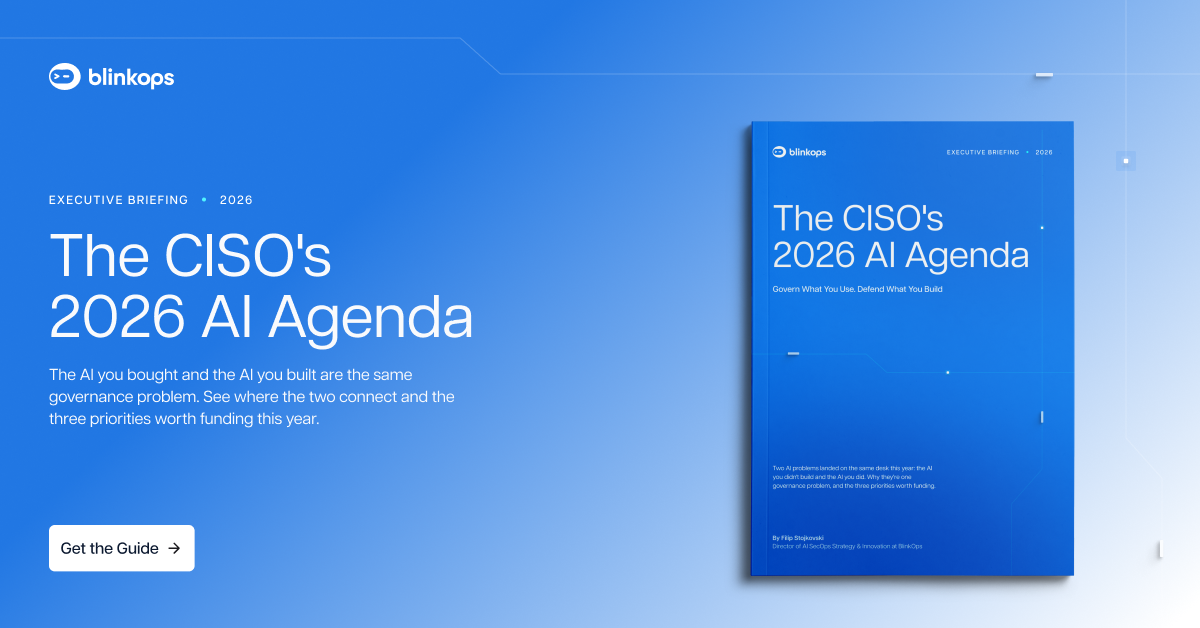
BlinkOps analyzed the dual AI challenge facing CISOs in 2026 and published everything in a free report. Download The CISO's 2026 AI Agenda here.
The problem isn't adoption. Security leaders are treating two converging risks as separate workstreams and building governance around the wrong assumptions.
An AI SOC applies artificial intelligence and autonomous agents to security operations workflows such as alert triage, enrichment, investigation, and response. Unlike traditional SOAR, which depends on static playbooks, an AI SOC uses reasoning agents that adapt across alerts, tools, and response paths while keeping humans in control at defined decision points.
Every AI agent authenticating with admin keys to your CRM, ticketing system, and email platform is a non-human identity running 24/7 with no human review loop. Gartner now names non-human identities as a top cybersecurity trend for 2026. Most of these identities haven't been reviewed since they were created.
Meanwhile, employees paste customer data, source code, and internal documents into public LLMs every day. Your DLP wasn't trained for an LLM tab open in the browser all day. Blocked URLs don't stop anyone with a phone.
The report maps exactly where shadow AI governance breaks down and which control surface matters more than the policy document sitting in your GRC tool.
68% of CISOs name AI for security operations as a top investment priority this year. That investment has not translated into consistent results.
The gap isn't budget. Most teams deploy AI everywhere at once instead of starting where it hurts: high-volume, low-judgment work like alert triage and enrichment. And they measure vanity metrics (“auto-closed alerts”) instead of lifecycle metrics. Did mean time to triage drop? Did detection quality improve? Did analyst hours shift from triage to engineering?
The report breaks down what separates AI SOC programs that deliver from those that produce dashboards, including the autonomy model most teams get wrong.
Want the full evaluation framework? Download The CISO's 2026 AI Agenda to get the govern-and-defend operating model, autonomy tiers, and measurement framework in one place.
The governance problem for AI you bought is the same governance problem for AI you build.
If you can't audit a decision your AI SOC triage agent made, you also can't audit a decision your dev team's pricing agent made. Most organizations are quietly building two separate governance models, two observability systems, and two teams owning what is fundamentally one problem.
The report lays out the three priorities that collapse these into a single operating model and why the companies that do it first will move faster on AI for the next three years.
The full report covers the complete govern-and-defend operating model: the risk shift from cloud to AI, a non-human identity governance framework, the autonomy tier model for AI SOC deployment, honest ROI measurement criteria, and the three budget priorities every CISO should fund this year.
An AI SOC is a security operations center that uses AI agents to handle alert triage, investigation, enrichment, and response. Where traditional SOAR relies on static playbooks, an AI SOC uses reasoning agents that adapt to each alert while keeping human analysts in control of high-stakes decisions through guardrails and audit trails.
Teams deploy AI on top of broken foundations: bad detections, fragmented data, no feedback loops. AI in that environment doesn't fix the process. It runs the broken process faster. Programs that succeed start with the highest-volume, lowest-judgment work first and measure lifecycle metrics, not vanity metrics.
Shadow AI refers to unsanctioned AI tools and agents used by employees without security review. It's the 2026 equivalent of shadow IT, but faster and cheaper to deploy. It includes public LLM usage, AI-embedded vendor products, and autonomous agents with unreviewed API access and no human oversight across enterprise systems.
Sources:
TechRadar: Businesses are taking action on AI security risks (77% stat)
ITPro: CISOs are keen on agentic AI (68% stat)
Gartner: Top Cybersecurity Trends 2026 (non-human identities)
Blink is secure, decentralized, and cloud-native. Get modern cloud and security operations today.