.webp)
.webp)

What Makes an AI Security Agent Production-Ready?
A production-ready AI security agent depends on the harness around the model: scoped tools, deterministic workflows, human approval, and audit.

A production-ready AI security agent depends on the harness around the model: scoped tools, deterministic workflows, human approval, and audit.



Building an AI security agent is no longer the hard part. Getting one to investigate an alert, call a few tools, and produce a convincing verdict is now well within reach for most teams. The harder problem is making that agent reliable enough to run continuously against production systems, without creating new operational risk.
I recently argued that AI SOC is becoming a commodity. Triage and investigation moved from differentiators to capabilities that dozens of vendors can now offer, which is why AI SOC is becoming commoditized. The real differentiation is moving down a layer, into the infrastructure that makes agents reliable, repeatable, governable, and useful in production.
That infrastructure is the agent harness, and it is where trust gets earned instead of asserted.
A production-ready AI security agent lives or dies on the system around the model: the harness, human approval gates, and full auditability.
The model does the reasoning. The harness is everything around it: tool execution, memory, context, state, permissions, approval gates, observability, evaluation, and the loop that lets an agent act.
When production agents fail, the model usually did not suddenly get worse. The surrounding system was not strong enough. So when you evaluate an agentic security product, evaluate what surrounds the model.
An agent with no skills is a chatbot with opinions, so start with what the platform gives each agent:
The last point matters most, because the production problem with agentic systems is not only accuracy. It is variance.
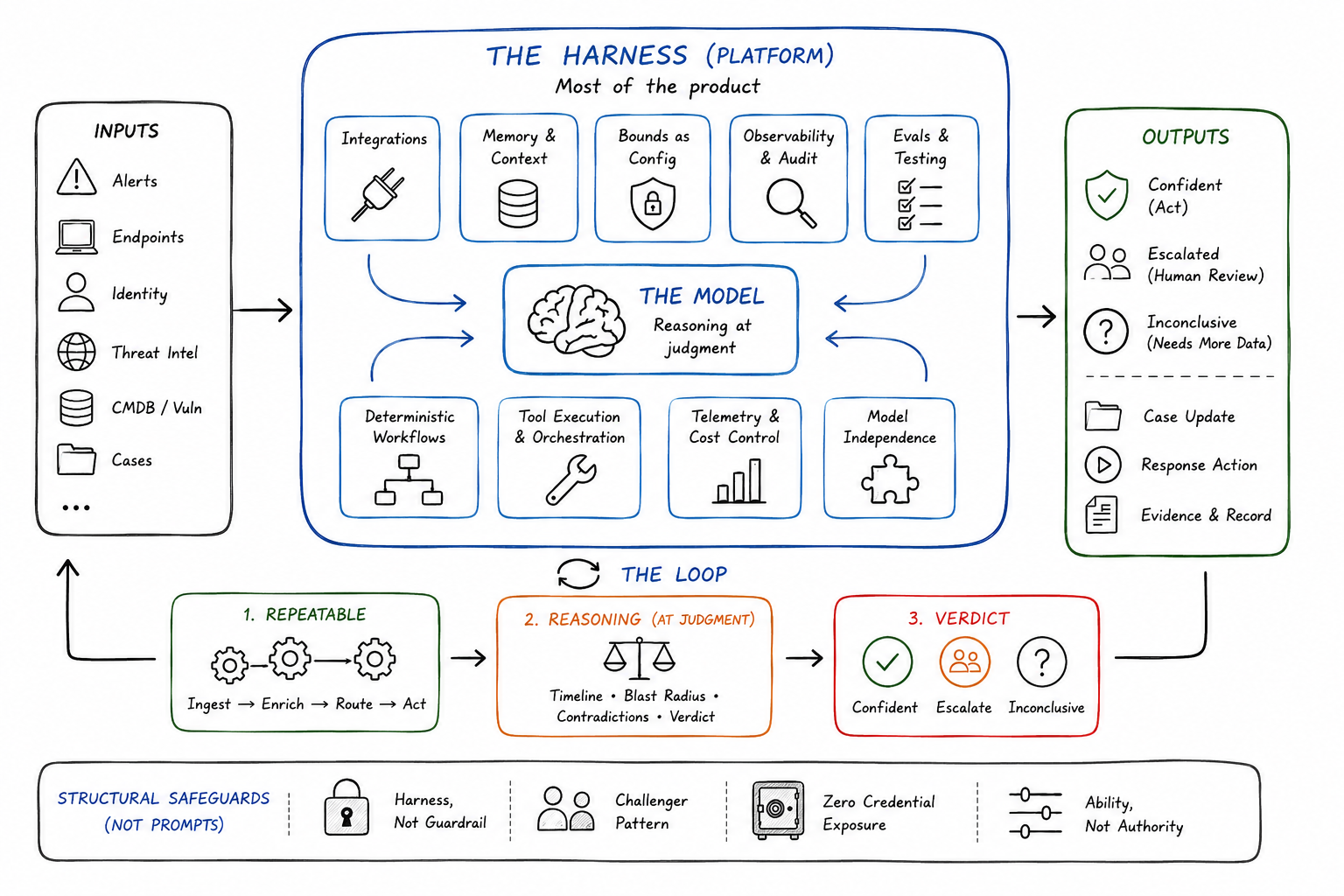
Most of a security workflow does not need a reasoning model, and forcing one onto every step adds cost and variance you do not want.
There is a version of AI SOC where one frontier model reasons over every step. Its bounds live in a prompt, and its output is graded by the same reasoning system that produced it.
Run the same alert three times and it may take three different investigative paths. Each path can look defensible on its own. But that variance becomes a problem when you need to test, audit, and operate at scale.
Most of a security workflow does not need that flexibility. Ingestion, deduplication, entity extraction, enrichment, routing, and known response actions should produce the same output from the same input. Those are deterministic problems.
Reasoning earns its place at judgment: reconstructing a timeline, understanding blast radius, reconciling contradictory evidence, and deciding whether behavior is expected before reaching a verdict.
BlinkOps maps this to the SUDA loop, and not every arrow needs an agent:
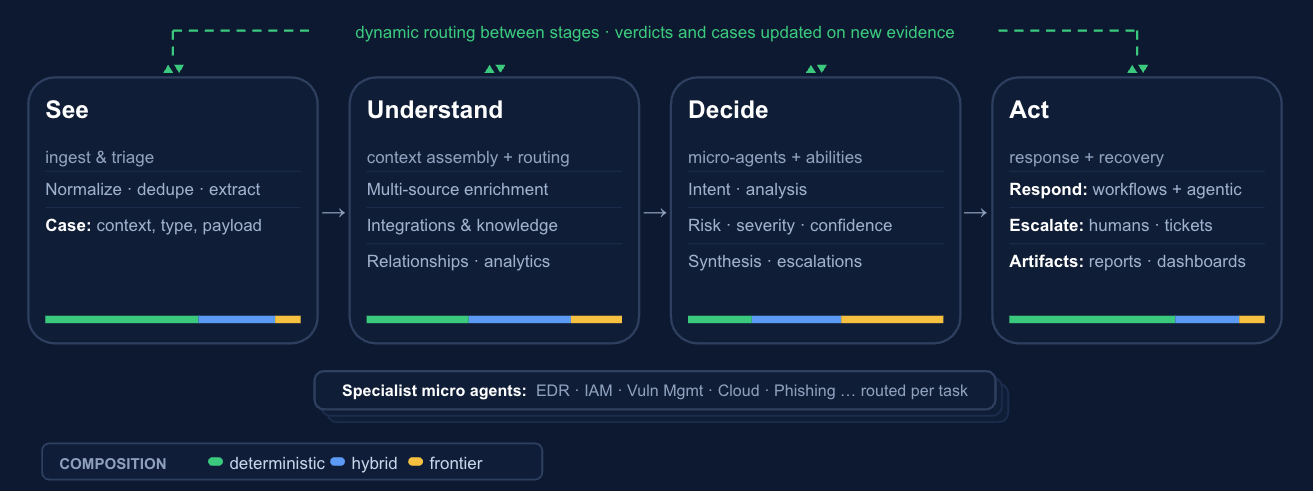
This matters for economics too. A platform that reasons over every lookup, enrichment, routing decision, and response step builds a cost that scales directly with alert volume. Reason where judgment is required, and execute deterministically everywhere else.
This is how BlinkOps’ AI SOC product works: deterministic workflows carry the load, and frontier reasoning runs only where judgment changes the outcome.
Speed is measured at case close, and every verdict is challenged before it stands, with humans in the loop where consequence demands it.
The right way to evaluate a production AI security agent is to ask what happens when it is wrong, not to compare accuracy percentages.
The industry tends to answer the trust question with accuracy claims. A better question is what the system does when it is wrong.
Eventually an agent will misunderstand context, receive incomplete evidence, hallucinate, or make a bad judgment. NIST catalogs this failure mode, which it calls confabulation and most people call hallucination, as a generative AI risk. The architecture around that failure matters more than another accuracy percentage.
A constraint written only in a prompt is still interpreted by the model it is meant to constrain. Prompt injection ranks first in OWASP's 2025 Top 10 for LLM applications, and OWASP itself recommends least-privilege access as a mitigation.
An agent holding broad credentials has too much authority when something goes wrong. A system that produces and validates its own verdict has no independent challenge before a consequential action.
A guardrail is a request. A harness is a bound. So the fixes belong below the model, in four layers:
This is least privilege applied to agents: NIST defines it as granting only the minimum resources and authorizations needed to perform a function.
This is what governed means: the constraint holds even when the model is wrong.
A prompt saying "never delete anything" is not governance. Governance is when the agent cannot delete. A control is decided in advance, enforced by the system, evidenced afterward, and gated at the point of consequence.
This is also more than RBAC. Access control answers who or what can reach a resource. Agent governance answers a different question: what may this reasoning process cause to happen when its reasoning is wrong?
Access control is part of that answer, not the whole answer. The constraint is also what buys the autonomy. Remove these controls and teams keep agents in recommendation mode forever.
Governance is not the tax on autonomy. It is the precondition for it.
A production-ready AI security agent, bounded by a harness with human oversight, should return an inconclusive verdict rather than force a binary answer.
One of the most revealing tests to run on any autonomous investigation system is whether it can say: I do not know.
Security does not always produce enough evidence for a clear malicious or benign call. A system forced into a binary answer will eventually manufacture certainty. A useful agent should return an inconclusive verdict and explain what blocked a conclusion: missing telemetry, insufficient retention, conflicting evidence, or unavailable context.
Blink AI SOC builds this in. A proposer drafts a verdict with cited evidence, a separate challenger attacks it, and an adjudicator returns Confident, Escalated, or Inconclusive.
That is useful operational data. If many inconclusive investigations point to the same missing telemetry, the agent has found something your detection engineering team can fix.
The best way to separate a production-ready AI security agent from a demo is to ask ten operations questions, not model questions.
Very few of these are model questions. They are operations questions, which is exactly why differentiation is moving away from the model and toward the platform around it.
Full autonomy for AI security agents is a phased rollout that expands as controls prove out, not a switch you flip on day one.
Deep machine investigation is already realistic for many high-volume, well-bounded cases: phishing, commodity endpoint detections, common identity anomalies, and repetitive cloud findings.
Multi-stage intrusions, low-signal cases, and investigations that depend on context outside your tooling are harder. Production autonomy should expand, not simply switch on. Start with recommendation, move into low-risk autonomous actions, and widen the boundary as the system proves itself.
Throughout, the agents stay a force multiplier for the team you already have, with humans in the loop where consequence demands it.
The models will keep getting better. The harder question for buyers is whether the system around the model can survive when the model is wrong. In production, the model is only one part of the product, and the harness is what makes it operational.
An agent harness is a platform-enforced bound the agent cannot see, negotiate, or reason around. It includes scoped tools, isolated execution, resource limits, circuit breakers, and approval gates that decide what an agent physically can and cannot do.
Reasoning models can produce different results on identical inputs, which makes them hard to test, audit, and operate at scale. Deterministic workflows handle repeatable steps like enrichment and routing the same way every time, so reasoning is reserved for genuine judgment calls.
A governed agent operates under constraints that hold even when the model is wrong. The control is decided in advance, enforced by the platform below the model, and evidenced afterward. It is not an instruction written in a prompt.
Yes, and it should. Security does not always produce enough evidence for a clear malicious or benign call. A trustworthy agent returns an inconclusive verdict and names what blocked it, such as missing telemetry or conflicting evidence.
Roll out autonomy in phases, not all at once. Start with recommendation mode, move into low-risk autonomous actions on well-bounded cases like phishing, then widen the boundary as controls prove out.
Blink is secure, decentralized, and cloud-native. Get modern cloud and security operations today.