.webp)
.webp)

Why AI SOC Is Becoming a Feature, Not a Category
AI SOC is becoming a baseline security capability. Learn why autonomous triage is commoditizing and how agentic security operations closes the loop.

AI SOC is becoming a baseline security capability. Learn why autonomous triage is commoditizing and how agentic security operations closes the loop.


Yes. AI SOC is commoditizing. What was a differentiator in 2025 is now an expectation any vendor holding alert data can claim, which turns autonomous triage into a feature rather than a standalone category. The durable advantage is moving to whoever owns the full loop, from signal to resolution, with reasoning bounded inside a harness and humans in the loop. AI SOC did not fail. It moved the bottleneck from detection to decision.
AI SOC went through a full market cycle in about three years. That is fast, even for security.
2023 gave us copilots that summarized alerts and took no action. 2025 proved AI could triage, investigate, and reach a verdict at machine speed. AI SOC became a real product category with real budget attached.
Then it got commoditized.
Walk any expo floor this year and count. Pure play vendors positioning on autonomous investigation. SIEM vendors claiming it. EDR vendors claiming it. NDR vendors claiming it. Data pipeline vendors claiming it after moving into detection. The number of companies advertising AI SOC in some form is now measured in the dozens.
That is not a criticism. Commoditization is what happens to a capability that works and that everyone can build. It means the capability stopped being a differentiator and became an expectation. I worked through this argument on Resilient Cyber, in an episode called "AI SOC Got Commoditized. Now What?".
Triage commoditized first because it was the one step that needed no write access. The industry started in the middle of the incident response cycle, and that was not an accident.
The pain was loudest there. Alert volume with no ceiling, analysts burning out on repetitive work, and the constant knowledge that something real is buried in the queue.
The risk was also lowest there. No write access required. No change management. No chance of breaking production. The system reads data, reasons over it, and produces a verdict a human can still override. The blast radius of being wrong is contained. Detection engineering sits to the left, tangled in log pipelines, telemetry gaps, and alert volume constraints. Response sits to the right, blocked by API limitations and approval processes. Both require write access to something that matters.
So the market went where the pain was and where the risk was lowest. That was the correct commercial decision, and because the surface was low risk, everyone made it. Any vendor holding alert data added an investigation layer. Some of it is a language model with a prompt attached. Some of it is a full agentic system with retrieval, memory, and tool execution. The gap between those two is enormous, and the marketing does not distinguish them.
The structural point stands. A capability that sits in one step of the workflow, requires no write access, and can be added by any vendor already holding the data is not a category. It is a feature.
Faster triage does not shrink the workload. It relocates it. Here is what happened to teams that deployed AI triage and declared victory.
Before AI, a SOC might process 200 alerts a day and make 100 meaningful decisions. In that same team, AI might surface 2,000 alerts, auto-close 1,700, and escalate 300 that require human judgment. In that illustration, the decision load roughly triples. Those numbers are a hypothetical industry pattern, not a BlinkOps result.
The mechanism is worth spelling out. Before AI, the queue was capped by human capacity. Teams knew it and worked around it. Low severity alerts were suppressed, sampled, or sent straight to a dashboard nobody opened. Entire detection categories stayed off because there was no one to look at the output. That was not a coverage decision. It was a staffing decision dressed up as tuning.
AI removes the cap. The suppressed alerts come back on. The noisy detections come back on. The categories that were never enabled get enabled. Volume goes up by an order of magnitude, and that is the intended outcome.
But higher throughput does not produce a fixed escalation count. It produces a proportional one. A small escalation rate applied to ten times the volume gives you several times the human decisions you had before. The machine absorbed the processing. It did not absorb the judgment.
The queue did not disappear. It changed shape. It used to be full of alerts that mostly did not matter. Now it is full of cases that survived machine investigation, which means the easy dismissals are gone and what is left is genuinely harder per item.
Gartner reached a similar conclusion. In its 2026 cybersecurity trends, Gartner found that AI-enabled SOCs enhance triage and investigation while raising the need for human-in-the-loop oversight and analyst upskilling.
Detection speed improved dramatically. Mean Time to Respond stayed flat. The new constraint sits between them, and it deserves a name: Mean Time to Decision.
There is a second-order effect on the detection side. When AI handles triage at scale, teams shift from precision-optimized detection to coverage-optimized detection. Deploy the broad rules you always wanted and let the machine sort the noise. That is directionally correct, but more coverage means more signals, more signals means more escalations, and if the detections are noisy the AI is processing garbage faster. With SOAR, bad detections cost analyst hours. With AI SOC, bad detections cost tokens, compute, and trust. Analysts watch the system confidently close garbage and start wondering what else it is confidently closing.
Faster triage does not fix bad detections and it does not fix a remediation backlog. It surfaces both.
Eliminating the triage step does not remove triage. It turns triage into a policy that somebody has to own.
Anton Chuvakin has been making the case that the classic pipeline of detect, triage, investigate should collapse into detect and investigate. If a machine can deeply investigate every signal, the cheap filtering step that existed only because humans do not scale has no reason to exist. He lays out the argument in his piece on why AI triage must die.
I agree with the direction. What follows from it is the part the market has not absorbed.
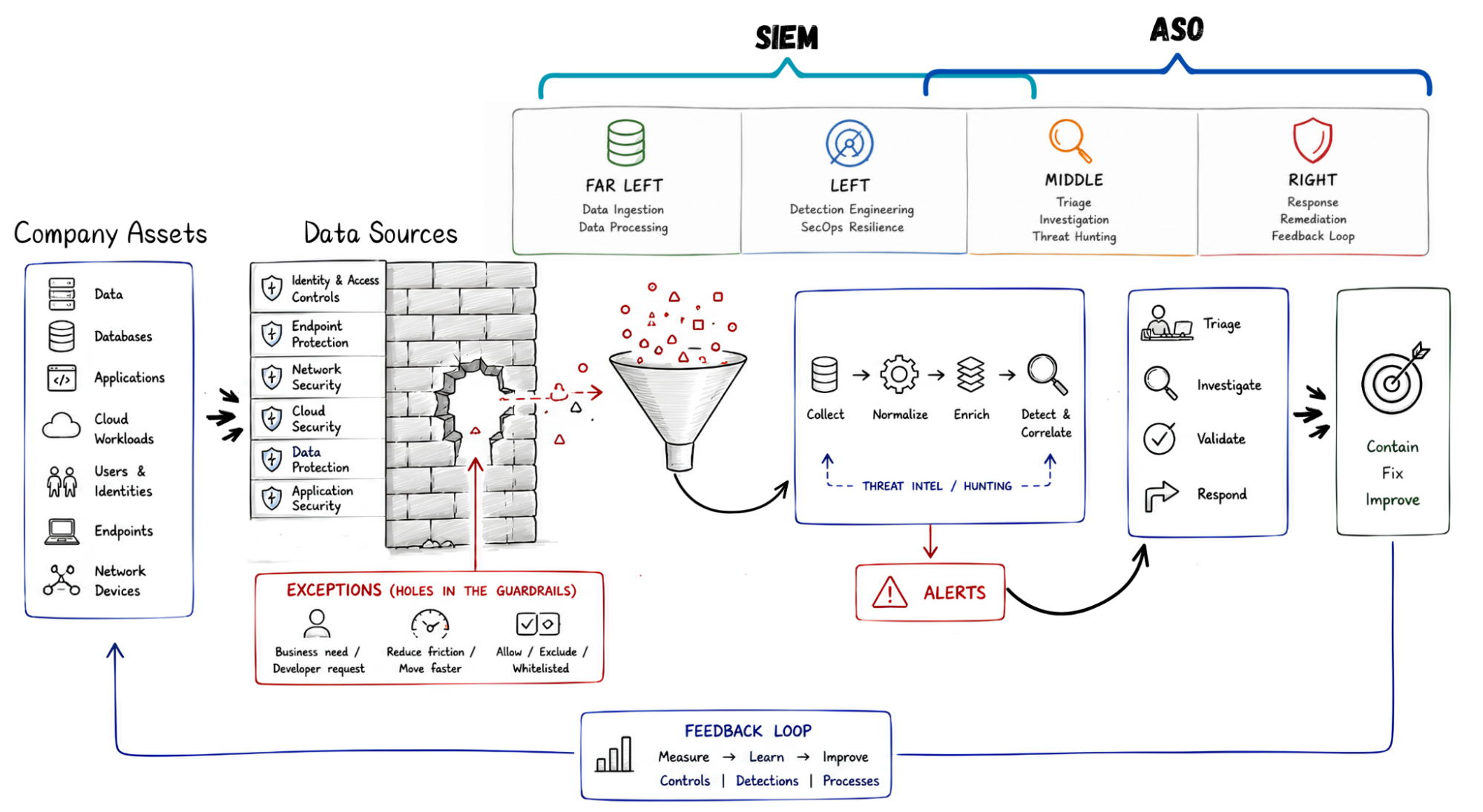
Triage does not disappear. It becomes a policy. Somebody decides how deep the machine goes on which alerts, and that decision now lives in configuration instead of in a human clicking a queue. Chuvakin calls this depth gating. Policies need owners, version history, review cadence, and audit trails. That is a governance requirement, and governance requirements are platform requirements.
The endpoint of the kill-triage argument is not a better triage product. It is an operating layer that owns policy, execution, and evidence across the whole loop.
The next decade of security operations will be won on the control plane, not the data plane. The past decade followed data gravity: centralize telemetry, gain visibility, generate insight. It worked until data outpaced the capacity to analyze it, and then it hit diminishing returns.
The next decade follows workflow gravity. Own the remediation workflow, own the security outcome. Visibility without action is expensive monitoring.
Security operations need their own version of the OODA loop. At Blink we describe it as the SUDA loop. See, Understand, Decide, Act, with governance and human-in-the-loop control around every step:
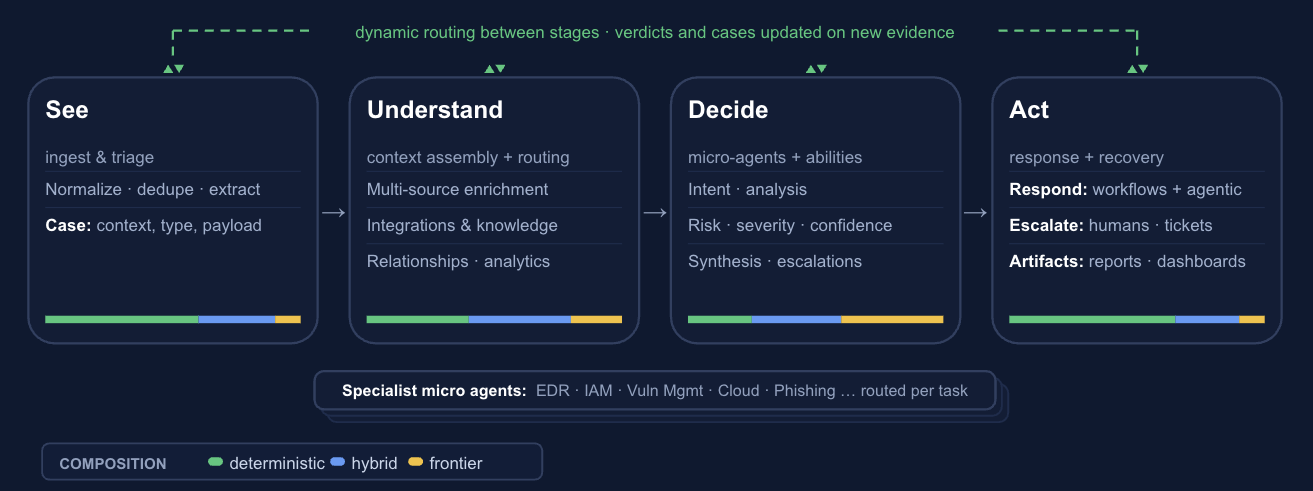
AI SOC, as the market defined it, covers Understand and part of Decide. It stops short of the action that closes the loop.
Tools that only see cannot act. Tools that only act cannot reason. Tools that only reason are brains without hands.
The teams getting value are the ones that closed the loop. The teams that bought a verdict engine and left remediation manual got faster alert closure and the same backlog.
The endpoint is not a narrow AI SOC and not a rebrand of SOAR. It is Agentic Security Operations (ASO) that combines capabilities which used to ship separately:
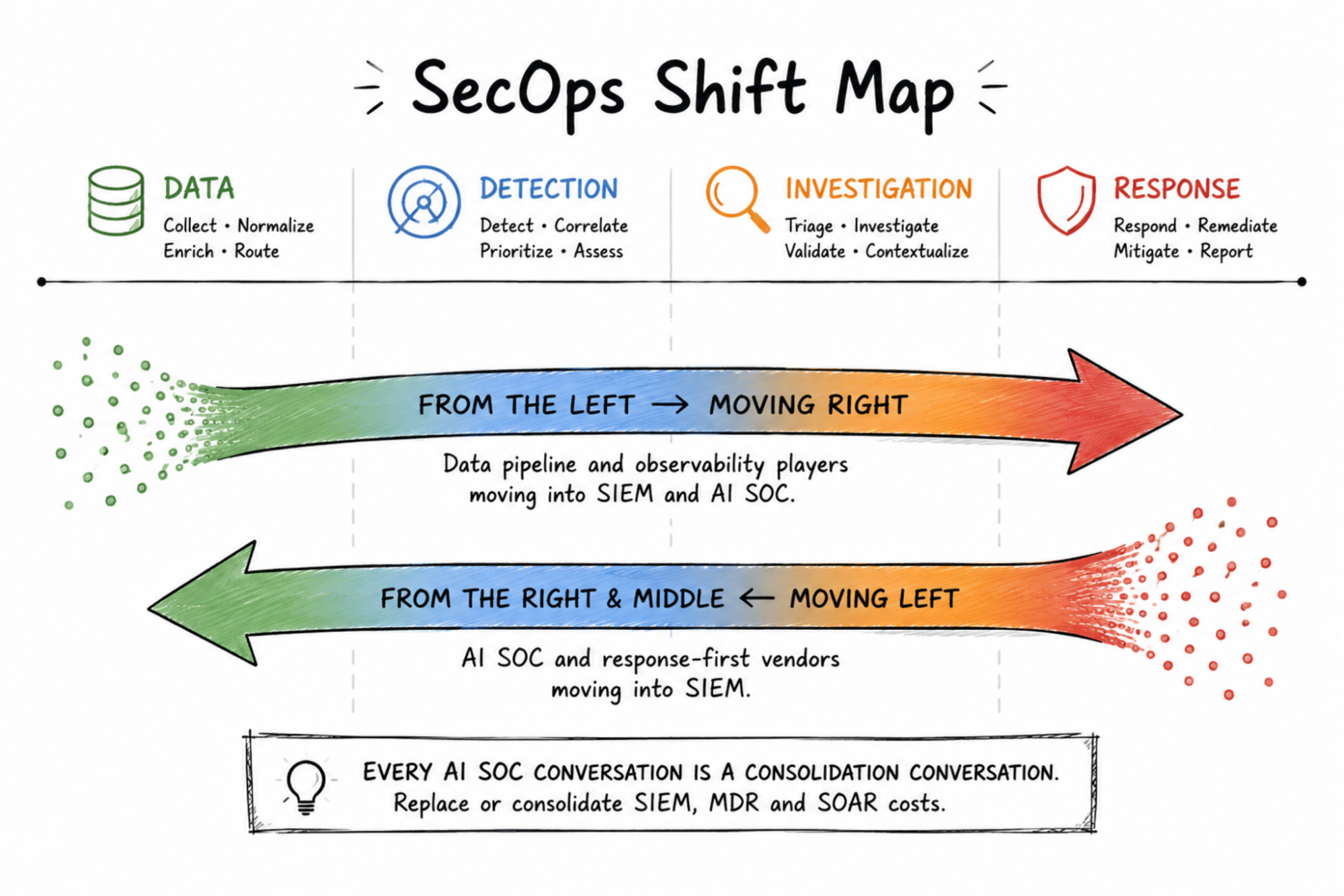
On the SecOps Shift Map, the far left is data pipeline and log ingestion, the middle is detection, triage, and investigation, and the right is remediation, containment, and the feedback loop. An ASOP sits in the middle and on the right. Everything that happens once an alert fires.
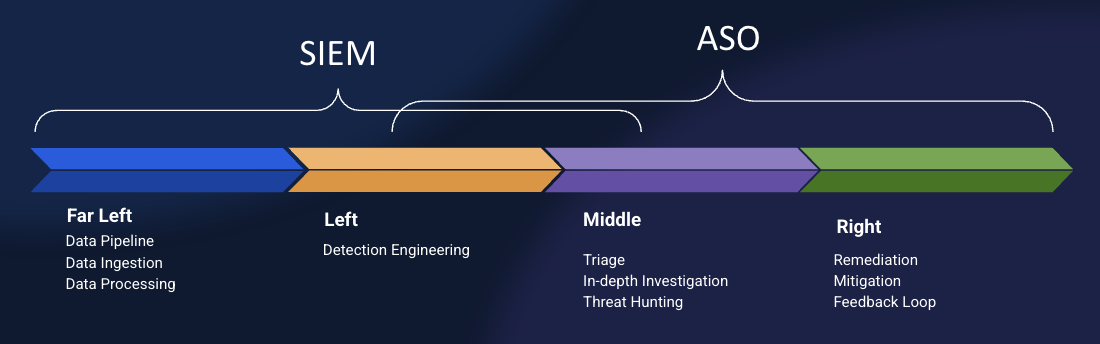
The left side is a different problem. Ingestion, parsing, normalization, and storage are data infrastructure. That work is real and it constrains everything downstream, but it is not agentic operations. A platform that tries to own the pipeline as well is building a SIEM, and that is a different bet.
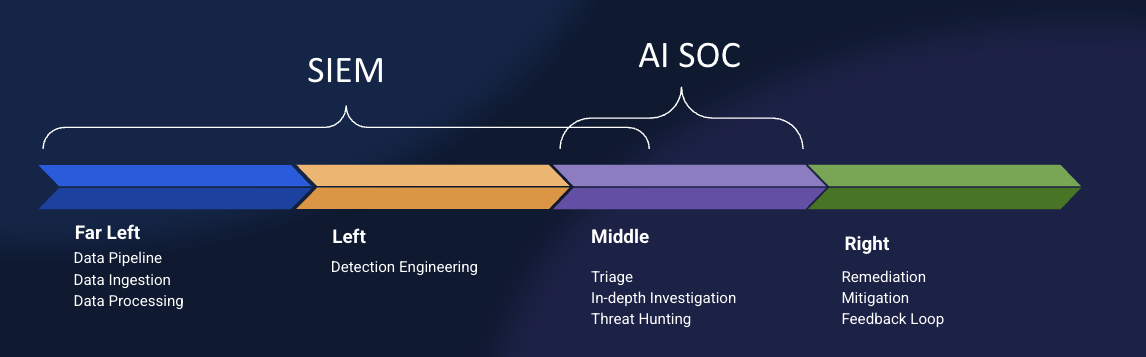
Detection engineering is the argument, and my position is that it belongs in scope. Detection is not a static artifact. It degrades as the environment changes, and the only thing that knows whether a detection is still working is the operational data on the other side of it. A detection that fired 847 times last month and auto-closed 812 as benign is telling you something specific, and the system holding that outcome data is the one positioned to act on it. The counter-argument is legitimate. Detection engineering is closer to data engineering than to operations, and on that reading it belongs on the left with the data. What is not defensible is leaving the feedback loop unowned, which is where most programs are today.
The reason this has to be a platform rather than a bundle is that every agentic security solution shares the same substrate. AI SOC, agentic vulnerability management, agentic IAM, agentic cloud security, and agentic GRC each need integrations, orchestration, case tracking, human collaboration, and governance controls. Building them independently means rebuilding the same infrastructure five times.
The right metric is outcomes, not throughput. If your SOC still reports alerts closed per analyst per shift, you are measuring a process that no longer exists.
The metric shifts from Alerts Triaged to Autonomous and Human-on-the-loop Resolutions. The question changes from how many alerts did we close to how many issues did we actually fix. That metric is uncomfortable because it exposes the gap. It is also the only one that connects security operations spend to a security outcome.
AI SOC was not a mistake. It went after the loudest pain in the SOC and it proved the thesis that machines can carry the analytical load. But it did not solve the problem. It moved it. The alert queue became a decision queue, and a decision queue only clears when something closes the loop and takes the action. That part is still open. Detections that produce signal instead of volume. Response that executes across a multi-vendor environment. Governance that survives an audit. Feedback loops that make the system better every month instead of more expensive every month.
This is the category Blink's Agentic Security Operations Platform is building toward: one platform that carries an alert from signal to resolution.
Distrust is the right default, so the standing line holds. Don't trust AI SOC. Verify it. Most of the category puts one frontier model in charge of triage, verdicts, and response, with bounds that live in a prompt. A guardrail is a request. A harness is a bound.
Agents reason. Workflows execute. The harness enforces. Agents handle the parts of security operations that require reasoning and judgment. Deterministic workflows handle the parts that should execute the same way every time. Case management, integrations, and governance provide the shared, auditable infrastructure around both, with humans deciding where the machine stops.
Four verifiable trust layers back that up, without asking you to take the category on faith:
The point is not to put an agent on every task. It is to let the system reason where reasoning is necessary, execute deterministically where it is not, and carry the workflow all the way from signal to resolution. Blink is a force multiplier for the team you already have, not a replacement for it. Nobody starts from zero. And nobody should stop at the verdict.
An AI SOC uses AI agents and deterministic workflows to enrich, investigate, decide on, and respond to alerts across the full incident lifecycle. In Blink, that reasoning runs bounded inside a harness, with humans in the loop and every action auditable.
No. An AI SOC is a force multiplier for the team you already have. It absorbs repetitive processing so analysts spend their time on judgment, and teams decide where the machine stops and the human starts.
SOAR runs scripted playbooks and can enrich and respond, but it cannot reason. An AI SOC adds autonomous investigation and verdicts, bounded by a harness and auditable at every step, so the system thinks as well as acts.
Mean Time to Decision is the time it takes to reach a trusted verdict and act on it. Once AI triage absorbs alert volume, it becomes the new bottleneck between fast detection and flat response.
It can investigate every alert, but the autonomy is bounded. The harness scopes what agents can do, the team sets the autonomy level, and humans stay in the loop wherever judgment matters.
That is the operator's case for owning the loop. The next post is the buyer's version: how to evaluate a platform that closes it.
Closing the loop from signal to resolution is the work AI SOC left unfinished. See how Blink carries an alert from detection through a governed, auditable response, with your team in control the whole way.
Blink is secure, decentralized, and cloud-native. Get modern cloud and security operations today.