.webp)
.webp)

What Is Alert Triage? A Complete SOC Guide
A practical guide to alert triage: what it is, how the process works, who owns it, and how AI is changing it when kept under a harness with human oversight and full auditability.

A practical guide to alert triage: what it is, how the process works, who owns it, and how AI is changing it when kept under a harness with human oversight and full auditability.


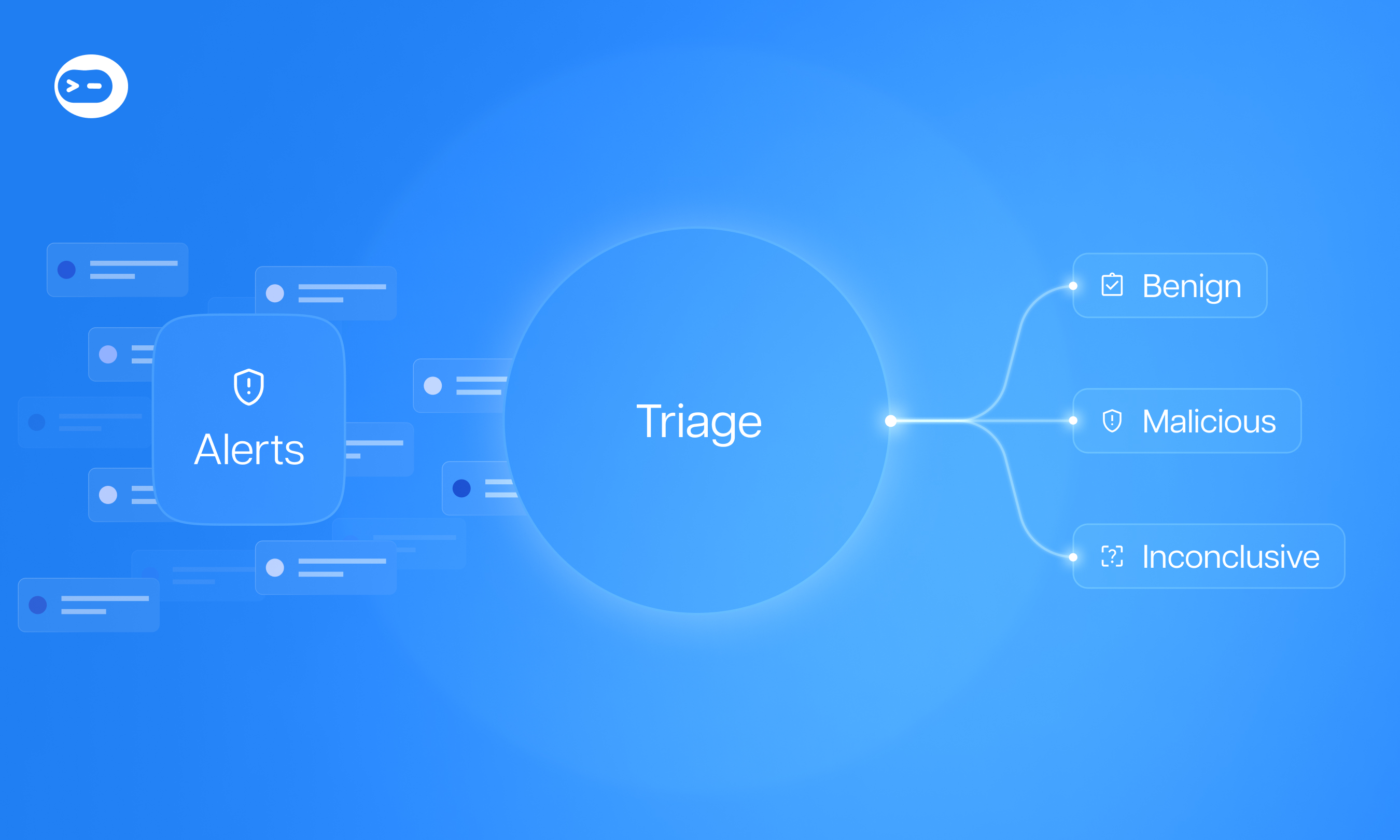
Alert triage is the structured process of reviewing, validating, categorizing, and prioritizing security alerts. The goal is to decide which alerts are real threats, how urgent they are, and what to do next.
The term comes from emergency medicine, where clinicians sort patients by how urgent their care is. In a SOC, analysts sort alerts the same way, so scarce attention goes to the highest-risk signals first.
Every analyst working an alert answers three questions. Is it real? How serious is it? What happens next?
Good triage does not end at a ranked queue. The outcome is a closed case with a clear verdict and a documented reason. That theme runs through this guide.
Alert volume outruns analyst capacity. Cloud adoption, remote work, and expanding attack surfaces push more alerts into the queue every year. Most of them are low fidelity or lack the context needed to judge risk fast.
Triage is how a team separates signal from noise at that scale. Done well, it surfaces active threats like lateral movement and data exfiltration before they escalate.
Many teams cope through what we call the funnel of fidelity. They narrow detections, raise thresholds, and accept blind spots to keep the queue survivable. That trade protects the team but shrinks coverage.
The better path shifts from precision-first to coverage-first: detect broadly, then use context and automation to triage the flood. This is part of the agentic SOC shift reshaping how teams scale.
The result leaders should target is throughput, coverage, and SLA attainment at flat headcount. Same team size, significantly more throughput.
Triage is the first decision point between detection and response. Detection tools such as EDR, NDR, IDS, identity, and cloud platforms generate alerts around the clock.
A SIEM centralizes those alerts in one place. Understanding SIEM and SOAR differences explains why volume piles up at the SIEM layer before anyone reviews it.
From there, triage decides one of three moves for each alert: escalate, monitor, or close. That single decision sets everything downstream in motion.
A useful frame for this loop is SUDA: See, Understand, Decide, Act. Analysts see the alert, understand its context, decide a verdict, and act on it.
Effective triage means earlier detection and focused response. Broken triage means overload, missed threats, and risk. Traditional SOC triage models often break here, because manual review cannot keep pace with the queue.
The alert triage process is best understood as five stages. Each maps to a step in the SUDA loop and moves an alert closer to a documented verdict.
Enrichment before review is the theme. When context arrives before a human looks, the analyst starts with evidence instead of raw data. This is where SOC automation matters most, since automation can prepare each case in advance.
Collect and normalize alerts from every source into one place, typically a SIEM. Extract and normalize observables so alerts from different tools speak a common language.
Deduplicate and identify related activity early. No source should be silently dropped. A dropped feed is an invisible blind spot.
Confirm the alert is real before anything else. Rule out sensor faults, misconfigured detections, and known-benign activity.
Then classify the alert by threat type and attack stage using a framework like MITRE ATT&CK. A meaningful share of alerts fail here as data-quality issues, not security events.
Attach identity context (role, history, and privilege), asset criticality, and threat intelligence before a human reviews. The same alert can be benign or critical depending on who, where, and what is involved.
Enrichment attached up front changes the analyst's starting point. They open a case with evidence in hand rather than a bare signal.
Score each alert by asset criticality, attack stage, threat-intel match, anomaly score, and business context. A tool-assigned severity is an input to this decision, not the verdict itself.
Watch for severity inflation and deflation. Both distort the queue and push analysts toward the wrong alerts.
Severity is not set once. As investigation adds evidence, risk, impact, and severity get reassessed. An alert that came in as low can become critical once you know the account is an admin and the host holds customer data. An alert that came in as high can drop once the activity matches an approved change.
Render a verdict and act on it. Escalate the alert, close it with documented reasoning, or route it to detection engineering for tuning.
Document every outcome for institutional memory, tuning, and audit. A closed, well-documented case is the outcome, not a faster queue.
Analysts weigh several categories when they render a verdict. A true positive is a real, malicious event. A false positive is an alert that fires with no real threat behind it.
A benign true positive is real activity that is not malicious, like an admin running an approved script. An inconclusive alert lacks enough evidence to call either way.
Analysts reach these calls through validation, behavioral comparison, and baseline context. They compare observed activity against normal patterns for that user, asset, and environment.
Miscategorization is costly both ways. A missed true positive lets a threat run. A flood of false positives buries the signal and drains the team. Tune detections after every false positive to reduce repeat noise.
Blink frames outcomes as three verdicts: benign, malicious, and inconclusive. Benign closes the case, whether the alert was a false positive or authorized activity. Malicious moves to response. Inconclusive is held honestly rather than forced. A high inconclusive rate points to a data or coverage gap, not a model problem. Vendors that offer only "malicious or benign" are faking certainty somewhere.
Tier 1 analysts own high-volume initial validation and filtering. They confirm alerts, clear noise, and pass real signals up the chain.
Tier 2 analysts handle deeper correlation and bridge to incident response. They connect related alerts into a coherent picture and decide when an alert becomes an incident.
Some organizations share triage with detection engineering, security engineering, or a virtual SOC. Leadership owns risk acceptance and high-impact actions. Clear ownership prevents gaps where alerts fall between roles.
As machines investigate volume, triage shifts from a job to a policy. Analysts move up to judgment, detection engineering, and threat hunting. That is a force multiplier for the existing team, not a replacement for it.
Alert fatigue is the first challenge. When alerts never stop, analysts desensitize and start to skim, and real threats slip past.
False-positive load makes it worse, and adding AI without context does not fix it. In the 2026 SANS AI Survey, 63% of practitioners report significant shortcomings when AI detects or responds to threats. False positives that waste analyst time are one of the three failure patterns the survey identifies, alongside missed novel threats and confidently wrong output.
Trust follows the same line. Automated incident response adoption sits at 39% in the same survey. Teams are willing to let AI enrich and sort, but not to let it act without oversight.
Missing context forces manual pivots across many tools. Tool sprawl adds pivot fatigue, and junior-analyst skill gaps widen the variance in decisions. Queue pressure pushes shortcuts, and without standardized criteria, verdicts drift from analyst to analyst.
There is also the maintenance trap. With unclear ownership, playbooks decay, and automation becomes shelfware when the champion who built it leaves.
The cost shows up in breach outcomes. IBM's 2026 Cost of a Data Breach Report found organizations took an average of 247 days to identify and contain a breach, up from 241 the year before and the first increase in five years. Attackers are using AI to move faster. Triage that cannot keep pace is where that gap opens.
Measure triage where the work ends. Faster triage is not an outcome. A closed case is. Track results at the closed case rather than the ranked queue.
One metric matters more once AI enters the queue: Mean Time to Decision. AI triage does not shrink the queue, it changes its shape. A team that saw 200 alerts a day can surface 2,000, auto-close 1,700, and still hand 300 to the same analysts. The machine absorbs the processing. It does not absorb the judgment. Mean Time to Decision measures the part that is left: how long it takes a human to make the call on what the AI escalated. If that number does not move, faster triage did not help.
The metrics below express health as throughput, coverage, and SLA attainment. Together they tell you whether the program is measurably improving.
These metrics enable continuous tuning. Each one points to a specific fix, from a noisy sensor to an over-eager auto-close rule.
Trust comes before speed. AI in triage only helps if leaders can control it, see its reasoning, and audit every action.
That control is what a harness provides. A guardrail is a request. A harness is a bound: a platform-level limit the agent cannot see, negotiate, or reason around.
Agents reason. Workflows execute. The harness enforces.
Inside that harness, automation handles enrichment, deduplication, and known patterns, while analysts keep judgment on the hard cases. Deterministic playbooks handle the patterns you wrote them for, and handle them well. Reasoning agents cover the rest of the queue. The distinction between AI SOC and SOAR explains why linear playbooks stall on the ambiguous cases.
The best design is hybrid. Deterministic workflows filter and route high volume. Reasoning agents work the judgment cases toward a benign, malicious, or inconclusive verdict.
Correlation is half the job. Re-scoring is the other half. The OpenAI and Hugging Face incident in July showed both failure modes: Hugging Face correlated the signals but did not raise the criticality, and OpenAI had the signals but did not connect them. An investigation engine has to do both, deduplicate and correlate events, then re-evaluate risk, impact, and severity on the evidence it gathered.
Adoption is now mainstream. Prophet Security's State of AI in the SOC 2026 report puts AI at 40% deployed and 56% in evaluation or pilot, with only 4% having no plans. The top reasons teams give are lower mean time to respond (73%) and better detection coverage (71%), followed by doing more with the same team (56%).
The payoff is measurable. In the same report, 72% of teams using AI say it cut alert investigation time by 25% or more, with an average reduction of about a third. IBM's 2026 report found organizations with extensive use of security AI and automation identified and contained breaches 65 days faster and at $1.93 million lower cost than those without.
Human-in-the-loop review and full auditability keep those gains trustworthy. IBM also found three quarters of leaders plan to deploy agents at higher rates in alert triage this year. The teams that get value from that will be the ones that can inspect what the agent did.
Triage and incident response are different jobs. Triage classifies and prioritizes alerts. Incident response contains, investigates, and remediates confirmed threats.
Triage output feeds incident response. Conflating the two creates gaps, because a team that never draws the line either escalates everything or investigates nothing.
Scope also extends well past triage. Deep investigation, malware analysis, timeline reconstruction, blast radius mapping, and governed remediation all follow. The next security domain gets built on the same platform, with no new procurement cycle.
Blink's AI SOC is built on the four core components Filip Stojkovski, Director of SecOps AI Strategy at BlinkOps, laid out in his SecOps Unpacked post, AI SOC Core Components, 2026 Edition: data ingestion, a knowledge graph, an investigation engine, and response with a feedback loop.
Every decision is human-in-the-loop and fully auditable, so you get a glass box, not a black box. Scope extends past triage into investigation and governed response.
This is modernization of legacy SOAR, not a rip-and-replace. It is a force multiplier for the existing team: same team size, significantly more throughput.
The outcomes below come from published BlinkOps customer stories:
See how governed, auditable triage would work in your environment. Request a demo.
Triage in cyber security means sorting incoming security alerts by urgency and risk, much like emergency medicine, to answer three questions for each one: is it real, how serious is it, and what happens next.
The alert triage process covers ingestion and centralization, validation and categorization, context enrichment, prioritization and severity assessment, and determination with documentation. Each step moves an alert toward a documented verdict.
Tier 1 analysts perform high-volume initial validation and filtering, and Tier 2 analysts handle deeper correlation and the bridge to incident response. Detection engineering, a virtual SOC, and leadership own supporting and risk-acceptance roles.
Alert triage classifies and prioritizes alerts to decide what deserves attention. Incident response contains, investigates, and remediates the confirmed threats that triage escalates. Triage output feeds incident response.
AI automates enrichment, deduplication, and known-pattern handling so analysts focus on judgment calls. It works inside a platform-enforced harness, with human-in-the-loop control and full auditability, rather than a black box acting alone.
Blink is secure, decentralized, and cloud-native. Get modern cloud and security operations today.