.webp)
.webp)

AI SOC vs Traditional SOC: Which "Traditional" Are You Actually Running?
Compare AI SOC vs traditional SOC models, from manual and SOAR-era operations to agentic AI, and see how roles, triage, response, and scaling change.

Compare AI SOC vs traditional SOC models, from manual and SOAR-era operations to agentic AI, and see how roles, triage, response, and scaling change.


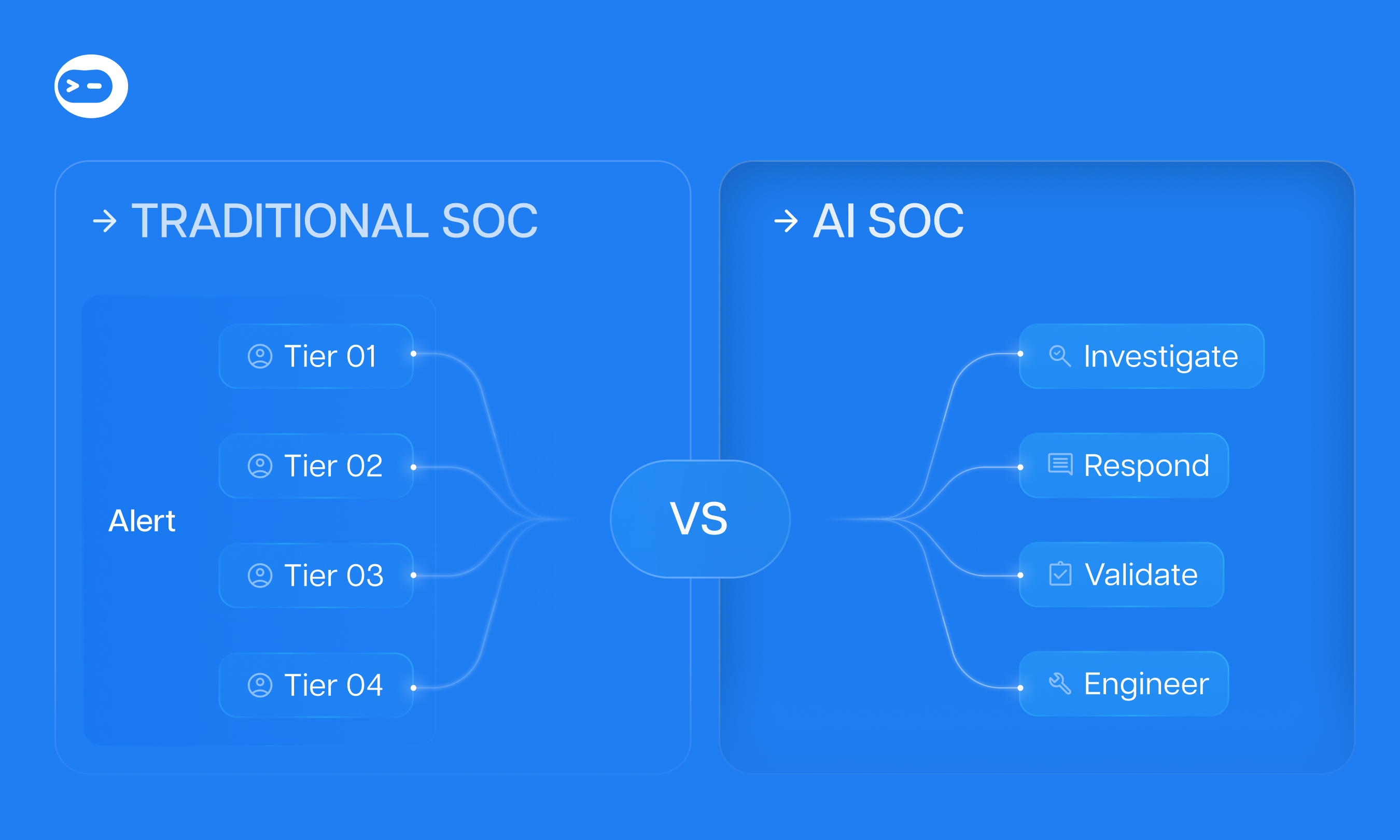
Most comparisons of AI SOC vs traditional SOC get the baseline wrong. They describe a fully manual SOC, all human analysts and alert queues, and then compare it against agentic AI. That SOC is the 2003 SOC. It still exists, but it's not that common anymore.
The SOC you probably run today is the 2013 SOC: SIEM for detection, SOAR for enrichment and a handful of hardcoded playbooks, and the same tiered analyst structure underneath it all. It already has automation. What it doesn't have is a different operating model.
That's the real difference between generations of SOCs. Not the tooling. The roles. A 2013 SOC automated tasks but kept humans doing the same job: sitting in a queue, triaging, escalating up the tiers. An AI SOC changes what the humans do. Analysts stop consuming alerts and start engineering the system that consumes them. Agentic AI handles investigation and governed response inside guardrails the team defines, and the humans shift into security engineering roles: building, tuning, validating, and owning the logic.
If you're evaluating modernization paths, this framing matters. Buying AI to make your 2013 SOC slightly faster gets you a slightly faster 2013 SOC. Restructuring around AI-driven investigation and engineering-led roles gets you a different SOC entirely.
The original model. SIEM aggregates logs, rules and signatures fire alerts, and alerts land in a queue. Tier 1 analysts triage, Tier 2 investigates, Tier 3 handles the hard cases. Static playbooks in PDF form. 24/7 shift coverage. Every unit of work is a human unit of work, so capacity scales linearly with headcount.
Triage exists in this model for one reason: humans are scarce and investigation is expensive. You can't deeply investigate every signal, so you invented a cheap filtering step to ration the expensive one. That compromise defined SOC operations for two decades.
Then SOAR arrived and automated pieces of the pipeline. Alert enrichment became automatic. Select alert types got triaged by hardcoded playbooks. Response actions could be scripted, though most still waited for analyst approval.
Here's what SOAR did not change: the roles. The tiered structure survived intact. Tier 1 analysts still sat in queues, just with more context pre-attached to each alert. Playbooks were deterministic, so anything outside the predefined path fell back to a human. Escalation still meant handoffs, and handoffs still meant context loss. Automation made the old process faster without questioning whether the process itself should exist.
This is the SOC most organizations run today, and this is what "traditional SOC" should actually mean in 2026. If your comparison baseline is the 2003 SOC, you're comparing against a museum piece and overselling the delta.
Here's the part that gets glossed over: an AI SOC is not something you get by adding AI tech to your current SOC. It's a people, process, and technology shift, and the operating model has to change with it. Anton Chuvakin makes the same argument in his Stop Building a 2003 SOC with AI series: bolt AI agents onto a legacy SOC structure and you get the same SOC, slightly faster and probably more expensive.
On the technology side, an AI SOC is a security operations center where agentic AI reasons through investigations, plans multi-step actions, and executes responses inside guardrails the security team defines. Agentic is the operative word. Unlike SOAR playbooks that follow rigid scripts, agents form hypotheses, query data, read the results, and change what they ask next. The investigation adapts to the evidence.
The other half is what happens to the people. When machines investigate the alert volume, the tiered analyst structure loses its reason to exist. Triage was a job because humans were the bottleneck. Remove the bottleneck and triage stops being a job and becomes a policy. The humans move from doing the work to defining the rules for the work.
To be clear, none of this is new as a discipline. Detection engineering and threat hunting have existed for years, usually as specialist tracks a small slice of the team moved into. What's new is the direction of travel: the AI SOC pulls the majority of analysts out of queue work and into these existing roles, because the queue is the thing that's disappearing, not the roles that were waiting on the other side of it.
A true AI SOC platform needs five core capabilities to support this model:
Detection is the layer people miscategorize most. Behavioral analytics and ML detection live in the SIEM and XDR layer, and that's true for the 2013 SOC and the AI SOC alike. An AI SOC sits on top of the detection layer rather than replacing it, working the signal those tools produce: investigation, response, remediation.
What most comparisons miss is that the AI SOC also closes the loop back into detection. Every investigation is feedback on detection quality. The AI SOC surfaces which detections are broken, noisy, or missing coverage, generates fixes for them, and creates new detections from threat hunt findings. In a 2013 SOC that feedback lives in a detection engineering backlog that rarely gets touched. In an AI SOC it runs as part of the operating cycle.
In the 2003 SOC, triage is a human clicking through a queue for minutes per alert. In the 2013 SOC, SOAR enriches the alert first, so the human clicks through a better-decorated queue. The pipeline stays Detect, Triage, Investigate, and only a fraction of alerts ever get real investigation because human investigation is rationed.
The AI SOC collapses the pipeline. When a machine can run a full investigation on every alert, the skin-deep triage step loses its purpose. Detect, then Investigate. For high-volume, evidence-rich alert classes like phishing, commodity EDR detections, and identity anomalies, deep machine investigation of 100% of alerts is achievable today. For multi-stage, context-heavy incidents, coverage is still a rollout, not a switch, and any vendor claiming otherwise is exaggerating.
One honest caveat: deep investigation costs compute, so investigation depth becomes a governed policy rather than a human decision per alert. That policy needs a named owner, version history, and review cadence, the same as any detection engineering artifact. This is precisely why the role shift matters. Someone has to engineer and own these policies, and that someone is your former Tier 2 analyst with a new job description.
2003: analysts execute playbooks by hand. 2013: SOAR can execute response actions, but they're prebuilt, brittle, and mostly gated behind analyst approval, so containment still waits on a human. AI SOC: governed autonomous response for routine threats, with the team defining in advance which actions run alone. Complex cases escalate to humans with the full investigation already assembled.
The tiered model escalates by handoff, and every handoff loses context as the next analyst re-familiarizes. The AI SOC has no tiers to hand off between. Context stays continuous through the investigation lifecycle, and when a human gets pulled in, they get the complete history, not a ticket summary.
Read the roles row twice. It's the row that separates the generations. Tooling changed between 2003 and 2013; the job didn't. The job is what changes now.
Augment, for most organizations. The replace-vs-augment framing is a false binary anyway. The practical path is layering AI-driven investigation and response on top of existing SOC infrastructure, then restructuring roles as trust builds.
The replacement anxiety is understandable but misdirected. The AI SOC doesn't eliminate the humans. It eliminates the queue. Analyst roles transform from reactive alert processing into engineering and hunting work, which is both higher-value and, frankly, the work most analysts wanted to do in the first place. Nobody joined security to close 200 tickets per shift.
There is one real trap to avoid: bolting AI onto your 2013 SOC without changing anything else. An old SOAR chained to a language model enriches beautifully and summarizes confidently, but it doesn't investigate. If you keep the tiers, keep the queue metrics, and keep measuring alerts closed per analyst per shift, you've bought a slightly better 2013 SOC and you're measuring a process that no longer needs to exist.
Decision factors that should guide your approach:
Four dimensions, in order of how often they get skipped:
Blink is an Agentic Security Operations Platform (ASOP), and AI SOC is the solution that runs on it. Rather than replacing your existing infrastructure, Blink integrates with your current SOC tools, more than 30,000 of them, to deliver fast and accurate triage, in-depth investigation, and governed response that scale with your alert volume.
Blink is built for the operating model this post describes, not for the 2013 SOC with a chatbot on top. Its hybrid architecture pairs deterministic workflows with agentic reasoning, so agents investigate while guardrails you define enforce what runs autonomously and what waits for a human. Every agent decision stays visible and auditable. Our AI is accountable, not just better: glass box, not black box. That auditability is exactly what detection engineers and AI validators need to do their job.
And AI SOC is where the conversation starts, not where Blink stops, because the same platform extends to vulnerability management, identity, and GRC.
Request a demo of the Blink agentic security operations platform.
The primary difference is the operating model and the human roles inside it. A traditional SOC, whether the fully manual 2003 version or the SOAR-augmented 2013 version, keeps tiered analysts processing an alert queue. An AI SOC uses agentic AI to investigate and respond across the security operations lifecycle within guardrails the team defines, and moves analysts into detection engineering, threat hunting, and AI validation, roles that already existed but were previously reserved for a small specialist slice of the team.
SOAR automates predefined tasks: enrichment lookups and hardcoded playbooks that run the same steps every time. Agentic AI investigates: it forms a hypothesis, queries data, reads the result, and adapts its next question to the evidence. SOAR made the tiered model faster. An AI SOC makes the tiered model unnecessary.
No. It replaces the alert queue, not the people. Routine investigation and governed response run on machines, while humans move into engineering the detection and agent logic, hunting for what machines miss, and validating AI-generated conclusions. The entry-level role shifts from queue triage to AI validation.
The detection layer itself stays where it is: behavioral analytics and ML live in the SIEM and XDR in every SOC generation, and an AI SOC sits on top of that layer. What changes is what happens around it. The AI SOC investigates, responds, and remediates on the signal those tools produce, and it closes the loop by flagging broken or noisy detections, generating fixes, and creating new detections from threat hunt findings.
Linear scaling and rationed investigation. Human capacity scales with headcount, so most alerts get shallow triage instead of real investigation, and genuine threats hide in the false positive pile. SOAR improved per-analyst throughput but didn't change either constraint.
Yes. Machine triage and investigation replace queue wait time, and governed autonomous response handles routine threats, which compresses the detection-to-containment timeline while keeping accuracy in check. Complex cases reach a human with the evidence already assembled instead of a raw alert.
Four factors: a documented operational baseline, telemetry quality good enough for machine investigation, mapped integration points with your existing stack, and a real plan for transitioning analyst roles toward engineering and validation. The last one is the most commonly skipped and the most decisive.
Blink is secure, decentralized, and cloud-native. Get modern cloud and security operations today.