What Is an Agent Harness, and Why Does It Make or Break Your AI Agents?
An agent harness is the framework that turns an LLM into a reliable, production-ready agent. It's the role, the tools, the context, the guardrails, the execution layer, the human checkpoints, and the audit trail. Without it, LLMs improvise. With it, they execute real work. This is the foundation of BlinkOps' Agentic Security Operations Platform (ASOP).
Uri Zaidenwerg
Published
September 1, 2026
Share this post
TL;DR: An agent harness is the framework that turns an LLM into a reliable, production-ready agent. It's the role, the tools, the context, the guardrails, the execution layer, the human checkpoints, and the audit trail. Without it, LLMs improvise. With it, they execute real work. This is the foundation of BlinkOps' Agentic Security Operations Platform (ASOP).
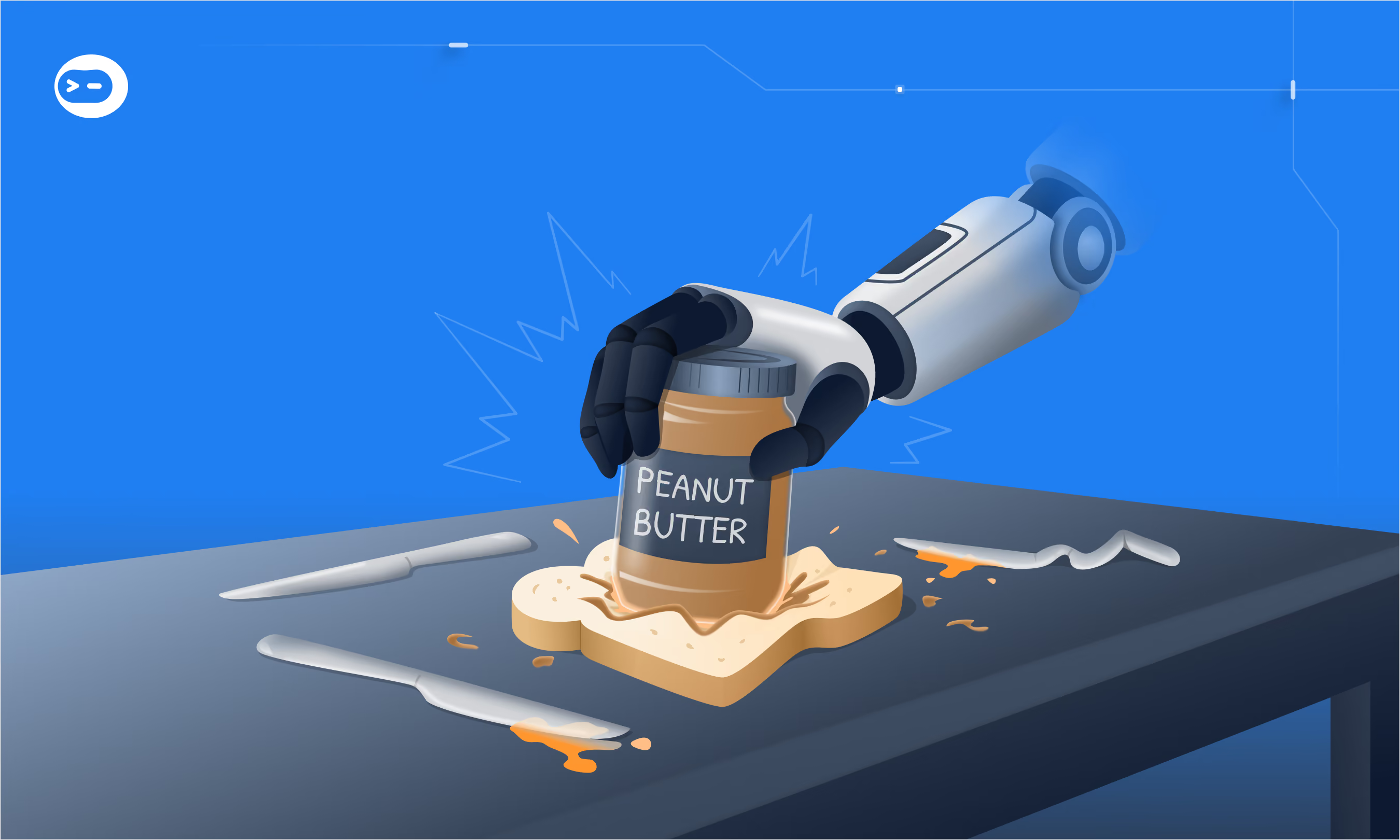
There's a viral video making the rounds in AI circles again. A dad sits at a kitchen counter while his kids write instructions for how to make a peanut butter and jelly sandwich. He follows their instructions literally. "Take one piece of bread, spread it around with the butter knife." So he picks up the bread and drags it across the counter with the knife, no peanut butter in sight. "Get some jelly, rub it on the other half of the bread." He rubs the closed jar of jelly on the bread. The kids scream. Sandwich after sandwich gets thrown away. The dad hasn't done anything wrong. He's done exactly what he was told.
If you've worked with LLM-based agents for more than a week, you know where this is going.
That video is the most accessible explanation of the agent harness problem I've ever seen. Understanding it is the difference between agents that ship to production and agents that get quietly shelved after a failed POC.
What Is an Agent Harness?
An agent harness is the scaffolding around a large language model that turns it from a text generator into something that can actually do work in the real world. The LLM by itself is a very capable pattern-matcher. It takes input, produces output. It has no memory, no tools, no boundaries, and no way to interact with your systems.
The harness is everything else:
The role and instructions that define what the agent is for
The tools it can call and the schemas for calling them
The context it has access to: knowledge bases, prior case data, organizational policies
The guardrails that constrain what it will reason about and what it's allowed to execute
The execution layer that actually carries out actions in external systems
The human checkpoints where a person reviews and approves before something irreversible happens
The audit trail that captures what the agent considered, decided, and did
Without a harness, an LLM is the dad in the video. Technically capable, incapable of producing the outcome you actually want.
Why LLMs Fail Without a Harness
Back to the sandwich. Watch the video closely and you see something interesting. The kids aren't bad at giving instructions. They know how to make a PB&J. They've made hundreds of them. Their instructions keep failing because they're missing the context the dad is deliberately ignoring.
"Get some peanut butter." He picks up the closed jar. "Put the knife in the peanut butter." He stabs it into the closed lid. "Spread it on the bread." He drags the empty knife across the bread.
The kids aren't wrong about what needs to happen. They're wrong about what can be left unsaid. Every instruction they write assumes the dad will fill in the obvious steps. Open the jar, scoop the peanut butter out, put it on the knife before the bread. He won't. He's a literal execution engine with no domain knowledge, no common sense, and no incentive to do anything other than exactly what the text says.
This is what happens when you hand an LLM a prompt and a bag of tools and tell it to "investigate this alert" or "triage this ticket." The model isn't stupid. It just has no idea what your environment looks like, what your runbook actually is, what counts as "done," what's a red flag, or what your analysts would never do. So it improvises. Improvising agents in production is how you end up with closed jars on bread.
This isn't a hypothetical risk. It's already showing up in the numbers. Gartner predicts more than 40% of agentic AI projects will be canceled by the end of 2027, due to escalating costs, unclear business value, or inadequate risk controls. The technology isn't the problem. The harness around it is.
What's the Difference Between a Good and a Bad Agent Harness?
By the end of the video, the kids figure it out. They rewrite the instructions with painful specificity:
"Take two pieces of white bread out of the bag. Take the lid off the jar of peanut butter. Get a butter knife and stick it inside of the peanut butter jar. With the knife, scoop some of the peanut butter out of the inside of the jar. Spread your scoop of peanut butter onto the face of one of your pieces of bread with the knife..."
And the dad finally makes a sandwich.
A bad agent harness is the first ten minutes of that video. A generic agent framework, broad instructions, a pile of tools, and a cheerful "go figure it out." Sometimes it works. Often it doesn't. When it fails, you can't tell why. Was the reasoning wrong? Was the tool call malformed? Did it hallucinate a step? Did it skip a check? You rewrite the system prompt, cross your fingers, and try again. That isn't an automation strategy. It's a science fair project.
A good agent harness is the final version of the instructions. It is:
Purpose-built. Designed for one well-understood job, not "general investigation" or "all of SecOps." The scope is narrow enough that the designer knows every edge case the agent will encounter.
Deterministic where it matters. The reasoning is flexible (that's the whole point of using an LLM), but the actions are not. The harness exposes a fixed set of capabilities, and every capability executes the same way every time.
Constrained on both sides. The agent is limited in what it's allowed to think about and what it's allowed to do. Two different problems, two different guardrails.
Human-checkpointed on anything irreversible. Shutting down a production host, disabling a user, deleting data. None of this happens without a person clicking approve.
Fully auditable. Every decision, every tool call, every input, every output is captured. When something goes wrong, you can reconstruct exactly why.
The kids didn't write better instructions by making them more general. They wrote better instructions by making them more specific to the task. Same with agents. A harness that's trying to be everything to everyone will be bad at all of it. A harness built for "triage an EDR alert on a Linux container workload" will outperform a generic SOC agent at that specific task every day of the week.
How BlinkOps Approaches the Agent Harness
The category we operate in, what we call the Agentic Security Operations Platform (ASOP), exists because the security industry hit the PB&J wall about eighteen months ago. Every major SOC team tried to build agents on generic frameworks. Some shipped. Most didn't. The ones that didn't ship failed for the same reason every time: the harness wasn't purpose-built.
BlinkOps' answer is Governed Agentic Execution. Deterministic workflow execution paired with governed AI reasoning. In practice that means:
Agents reason, workflows execute. The LLM decides what to do. A deterministic workflow built in Workflow Studio actually does it. The agent never touches a live system directly. It invokes an ability, a pre-built, tested, versioned workflow, and the workflow is what talks to CrowdStrike, AWS, ServiceNow, or whatever else. This hybrid execution model is what separates production-grade agents from demo-grade ones.
Abilities, not tools. An agent's capabilities are the set of workflows explicitly assigned to it. Not "the internet." Not "every integration we have." A specific, curated list of things this particular agent is allowed to invoke. This is the scoop-peanut-butter-out-of-the-jar level of specificity.
Dual guardrails. Reasoning guardrails constrain what the agent considers. Action guardrails constrain what it can execute. The video's dad had neither. He'd consider anything and execute anything, as long as it was spelled out. Real SOC agents need both.
HITL at the platform level. Sensitive actions route to a human for approval through the Blink UI. This isn't a feature you build into each workflow. It's enforced by the platform. The agent can't skip it.
Full auditability. What the agent considered, why it decided, which ability it invoked, what the outcome was. All captured, inspectable, explainable.
Customizable end to end. Custom actions, custom knowledge, custom agents. Your detection engineers build abilities. Your IR team composes agents. Your tier leads set the guardrails. Everyone works on one platform.
Compare that to the alternatives:
AI SOC products ship investigation agents with shallow response capabilities and limited customization. A pre-made sandwich. Take it or leave it, hope it's the one you wanted.
SOAR platforms have the workflows and integrations. They're catching up on the reasoning layer, but the agent is bolted onto the workflow paradigm rather than treated as a first-class layer with its own harness primitives. The kitchen with most ingredients laid out and a chef still learning the menu.
Agent frameworks (LangChain, CrewAI, raw APIs) have agents but no native enterprise integrations, no governance, no HITL, no audit layer. The dad with a butter knife and no instructions.
BlinkOps gives you the kitchen, the ingredients, the recipe, the chef, and the taste-tester on one platform. Built so your team can extend any of it.
The Takeaway
The agent harness isn't a nice-to-have layer on top of your LLM. It is the product. The model is a commodity. The harness is where all the engineering, all the domain knowledge, all the hard-won operational lessons actually live.
A good harness is narrow, specific, deterministic where it matters, constrained on both sides, human-checkpointed where it counts, and fully auditable. A bad harness is generic, ambitious, hand-wavy about guardrails, and impossible to debug when it fails.
The PB&J video is funny because the kids' instructions aren't specific enough and the dad is being a jerk. In production AI, the LLM is always that dad. The only question is whether your harness gave it instructions good enough to make a real sandwich, or whether it's going to hand you back bread with a closed jar rubbed on it and call the job done.
Build the harness for the job. Not for everything. That's the difference.
FAQ
What is an agent harness?
An agent harness is the framework around an LLM that turns it from a text generator into a system that can do real work. It includes the agent's role and instructions, the tools and integrations it can call, the context it has access to, the guardrails on its reasoning and its actions, the execution layer that performs the work, the human checkpoints for sensitive steps, and the audit trail that records everything. The model is the brain. The harness is the body, the skeleton, and the rules of engagement.
What does a good agent harness include?
Six things. A narrow, well-defined scope. A fixed set of capabilities the agent is allowed to invoke. Reasoning guardrails that constrain what it considers and action guardrails that constrain what it executes. Human-in-the-loop checkpoints on anything irreversible. Deterministic execution for the actions themselves. And full auditability of every decision, tool call, and outcome. Miss any of these and you're rebuilding it later under pressure.
Why do AI agents fail in production?
The model is rarely the problem. Agents fail because the harness around them isn't purpose-built. The scope is too broad, the tool surface is too wide, there's no separation between reasoning and execution, no HITL, no audit. The agent improvises, something breaks, and nobody can explain why. Gartner predicts over 40% of agentic AI projects will be canceled by the end of 2027 for exactly these reasons: escalating costs, unclear value, and inadequate risk controls.
Is the agent harness the same as an agent framework?
No. A framework like LangChain or CrewAI gives you the primitives for building agents. The harness is the specific configuration of those primitives plus everything around them: integrations, guardrails, HITL, audit. A framework is a toolkit. A harness is the assembled product. You can build a harness on top of a framework, but a framework alone is not a harness.
Can't we just use the model directly with function calling?
You can. Most teams that go this route end up rebuilding the harness layer themselves over six to twelve months. Function calling solves tool invocation. It doesn't solve guardrails, HITL, audit, or governance. Those are separate engineering problems and they compound.
How is this different from SOAR with an LLM bolted on?
SOAR is the execution and integration layer. A harness includes execution, but also reasoning scope, dual guardrails, and platform-level HITL. SOAR with an LLM bolted on usually treats the LLM as a tool the workflow calls. A real agentic system inverts that. The agent decides which workflow to call, and the platform enforces the rules around what the agent is allowed to decide.
What is the right scope for a single agent?
Narrow. "Triage CrowdStrike detections on Linux container workloads" is a good scope. "Triage all alerts" is not. The narrower the scope, the more predictable the behavior and the easier the audit. If you can't enumerate the edge cases on a whiteboard, the scope is too wide.
How do you handle model upgrades?
Because reasoning and execution are separated, model upgrades are isolated. The agent's prompts and instructions live in the harness. The workflows don't change when the model changes. You can swap models, run them in parallel, A/B them on the same alert stream, without touching the integration layer.
What about cost compared to building this ourselves on Lambda or Azure Functions?
Custom cloud automation looks cheap because the compute hides inside the existing cloud bill. The real cost is engineering time. Connector maintenance, auth rotation, error handling, audit infrastructure. Teams that build their own harness tend to underestimate this and end up with a platform only one engineer can maintain. The cost picture changes meaningfully once those engineering hours are factored in.

.webp)
.webp)




.avif)
.avif)
.avif)
%20(1).avif)