.webp)
.webp)

How to Replace SOAR with an Agentic SOC Platform
Why Security Leaders Are Moving From SOAR to Agentic Security Operations

Why Security Leaders Are Moving From SOAR to Agentic Security Operations


Let me skip the AI hype and start with what actually matters to you.
A lot of CISOs learn the same boardroom lesson the hard way: the board doesn’t care what tool you deployed. They care what risk you reduced and what cost you avoided.
That’s the right frame for AI transformation too. The question isn’t “are we using AI?” The question is: did we reduce exposure time, scale coverage, and cut operational cost as the company grows?
If your environment is growing 3x while your team grows 10-15%, you don’t have a tooling problem. You have an operating model problem. SOAR was a big step forward because it automated enrichment and response actions once a human decided an alert was real. But SOAR can’t reason through the messy part, triage and decision-making, especially as threats change daily. Some triage-only tools on the market, often labeled “AI SOC,” help with triage but still require SOAR for response, which pushes the bottleneck downstream. That’s why replacing SOAR isn’t really about playbooks. It’s about moving to agentic security operations: reasoning and execution running end-to-end on one platform, where agents reason, workflows execute, and guardrails enforce.
Here is the terminology, kept tight so the business case stays clear. Blink is the Agentic Security Operations Platform (ASOP), the foundation you build on. On top of it, replacing SOAR maps to two shipping solutions: Agentic SOAR, the 3rd generation of SOAR (low-code, no-code, and agentic) for automation, and Agentic SOC, which covers the full alert lifecycle from triage through investigation, response, and remediation. “AI SOC” stays what it is in the market: a term for triage-only competitors, not a BlinkOps product.
Every technology decision in security usually ladder up to three business outcomes:
When you ask the board for budget, they need to hear outcomes, not acronyms. The difference looks like this:
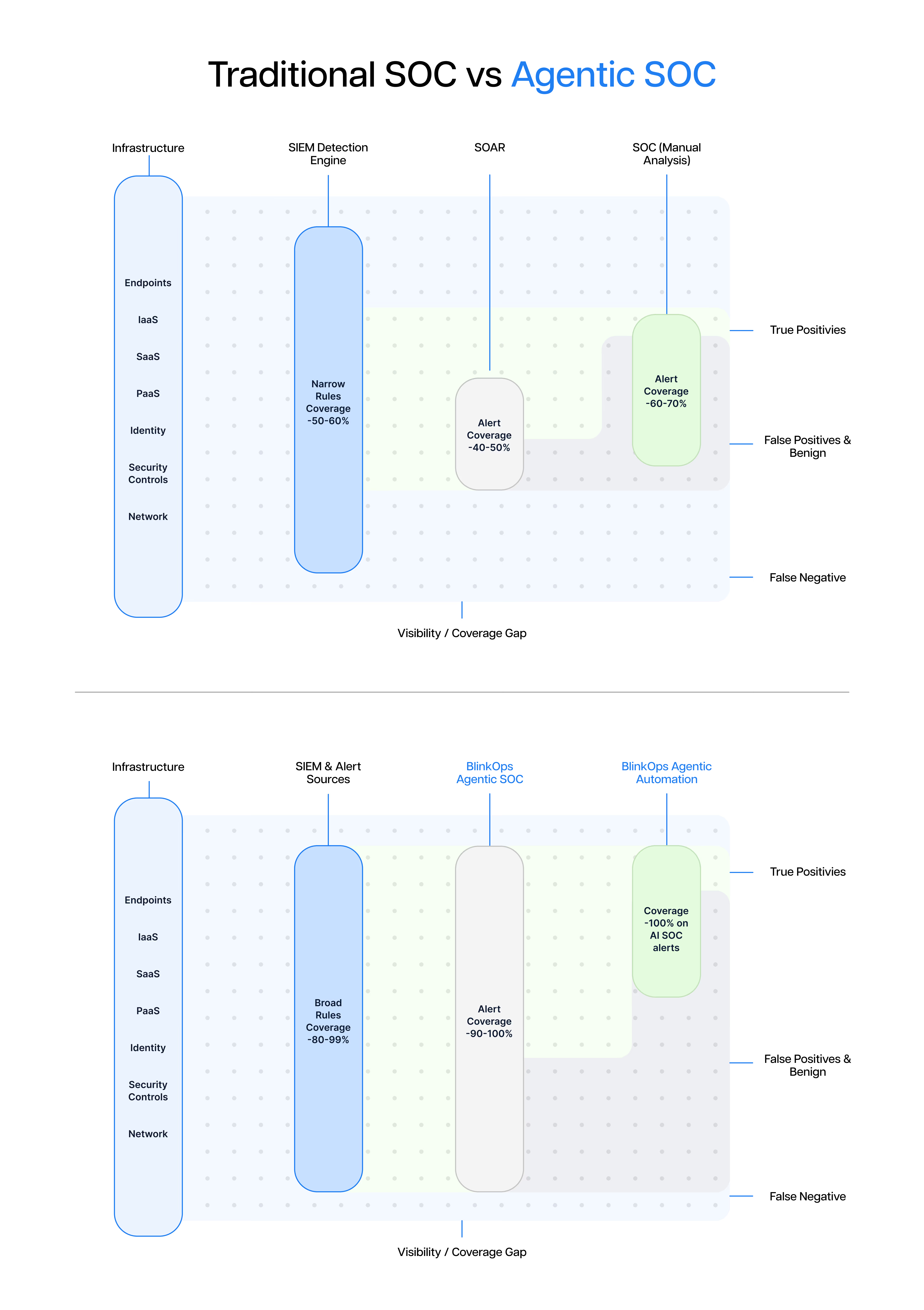
The math is straightforward but devastating:
This creates a compounding bottleneck. It’s not a staffing problem you solve with one more hire. It’s a structural problem with how security operations work.
SOAR helped with the middle of the workflow: enrichment and response. Once a human decided an alert was worth investigating, SOAR could enrich data, pull context, and execute containment. That was real value.
But SOAR couldn’t help with triage. It couldn’t look at an alert and reason: is this real? Is this noise? What should I check? Because threats change daily. The playbook you coded last month doesn’t catch what shows up tomorrow.
Now, a wave of AI SOC products promise to fix triage. Some do it well. But here’s what they don’t tell you: they push the bottleneck from triage to response. The AI triaged 1,000 alerts. Who acts on the 200 that need containment? “Oh, for that you’ll still need your SOAR.”
So now you’re paying for two platforms. The bottleneck moved. It didn’t disappear. And when the CFO asks what all this spending got you, the answer is: more vendors, same problem.
Legacy SOAR hit a “Force Multiplier Ceiling.” A team of 10 operates like a team of 15-20. That was fine in 2020. It’s a failing strategy in 2026. When you ask for more SOAR budget, the CFO hears: “I want to pay more for a tool that still requires me to hire more people to manage it.”
Beyond the multiplier ceiling:
Now every SOAR vendor is bolting on an LLM and calling it “AI-powered.” Adding a chatbot to a playbook engine doesn’t make it agentic. It makes it a playbook engine with a chatbot.
Agentic Security Operations (ASOP) changes the formula. Instead of a flowchart, you give an AI agent a goal: “Investigate this alert and recommend response if the risk is verified.” The agent reasons. It decides which tools to query, what context is missing, and what conclusion is justified. When threats change, the agent adapts. No engineer needed to update the logic.
An agentic SOC is a security operations model where reasoning agents work the full alert lifecycle (enrich, investigate, decide, respond) inside guardrails and human-in-the-loop control, with a full audit trail on every action, so agents reason, workflows execute, and guardrails enforce.
For a security leader, this isn’t just better tech. It’s the only way to scale without a $10M hiring plan. Your infrastructure grows. Your alerts grow. But with agentic operations, your capacity to investigate and respond grows with them, without linear headcount increases.
Here is how the three models compare. “AI SOC” below is the market term for triage-only tools, not a BlinkOps product. BlinkOps ships Agentic SOC and Agentic SOAR on one platform, and you can Replace Your Legacy SOAR with automated migration tools.
What you need isn’t an AI SOC tool + a SOAR tool + a case management tool duct-taped together. You need one platform that handles the full incident lifecycle:
End to end. No handoffs. No gaps. No vendor multiplication.
The biggest hurdle to adopting Agentic SOAR isn’t the technology, it’s trust. Handing “reasoning” over to an AI can feel like giving your car keys to a teenager. You know they’re fast, but you aren’t sure they’ll follow the speed limit.
We solved this by moving away from “black box” AI and toward a layered governance model. Trust in an ASOP is built on three specific pillars:
This is the “Brain” layer. You don’t just set an agent loose; you define the policies that shape its decision-making before a single action is considered.
This is the “Hands” layer. Even if an agent decides an action is necessary, it can only pull from a pre-approved toolkit.
In a legacy SOAR, if a playbook fails, you dig through code. In some AI tools, you just get a result with no explanation. ASOP provides a complete Reasoning Trace.
For the business case: you consolidate multiple tool costs (SOAR + AI SOC + case management) into one platform while dramatically increasing operational output. Investigation time drops significantly. A single operator managing micro-agents , producing outcomes like a team of 50. Full platform, all capabilities, from day one. No upsell gates.
We built Blink because security shouldn’t be a collection of disconnected silos. It should be a unified platform where you build solutions, not just buy tools.
Blink is the Agentic Security Operations Platform (ASOP). Agentic SOC and Agentic SOAR are the shipping solutions built on it. The platform has the following core capabilities:
Think of it this way. Sales runs on Salesforce. IT runs on ServiceNow. HR runs on Workday. Blink is that platform for security.
Stop being a technical expert talking to confused executives. Become a business partner explaining opportunity. Use this structure for your next ASOP pitch:
The board care about business risk, financial impact, and customer trust.
Your infrastructure will keep growing. Your alert volume will keep growing. The only variable you control is whether your operations can scale with that growth. ASOP isn’t just an upgrade. It’s the operational math required to survive the next era of security.
The organizations that move first will have a real competitive advantage. Not because AI solves everything on its own, but because they’ll operate at a scale that’s impossible with the old model. Security starts being a business enabler.
In the boardroom, you aren’t a security leader. You’re a business leader who happens to know security.
Agentic Security Operations Platform. It provides the foundation for agentic transformation by enabling organizations to design, deploy, and manage specialized security micro-agents. Combined with BlinkOps’ AI-as-a-Service, teams can deliver enterprise-grade, agent-driven security solutions across the organization.
Yes. ASOP does everything SOAR did (orchestration, enrichment, response automation) plus what SOAR couldn’t do (triage, investigation, reasoning). You consolidate tools, not add another one.
AI SOC vendors handle triage but push the bottleneck to response. You still need SOAR for containment and remediation. ASOP handles the full lifecycle end to end: triage through remediation in one platform.
Days to first value, not months. Most teams deploy their first agentic solution within the first week, or use plug-and-play solutions from day one. Initial triage runs in under 60 seconds, and Agentic SOC is built for 100% alert investigation rather than per-alert sampling, with humans in the loop. The economics compound as you expand to more use cases.
Yes. Same platform, same integrations for IAM, Cloud Security, GRC, Vulnerability Management and AppSec. One investment covers every security domain, not just SOC.
Blink has proprietary migration tooling that converts deterministic playbooks into platform workflows. You’re not starting from zero. Bring what works, layer agentic reasoning on top.
SOAR automates predictable, pre-decided tasks well, but it can’t reason. It runs static playbooks, so when a threat shifts even slightly the flowchart breaks and an engineer has to rewrite it. That leads to playbook sprawl and maintenance debt: ballooning playbook counts with unclear ownership, connectors that fail when a vendor changes an API, and programs that become shelfware when the champion leaves. Per-seat and per-module pricing also caps adoption, so a powerful platform ends up usable by only a handful of people. In short, SOAR handles execution but leaves triage and decision-making on human shoulders.
The strongest alternative is one platform that keeps SOAR’s deterministic reliability and adds the reasoning layer it never had, rather than bolting a second tool onto the stack. On Blink, that is Agentic SOAR, positioned as 3rd-generation SOAR (low-code to no-code to agentic), paired with Agentic SOC for the full alert lifecycle. The operating principle is agents reason, workflows execute, guardrails enforce, with human-in-the-loop control and a full audit trail on every action. Blink stays vendor-neutral across 30,000+ integrations, so the right alternative works across the tools you already own instead of locking you into one stack.
You don’t start from scratch. Automated migration tools convert your deterministic playbooks into platform workflows, so the logic that works keeps working. From there you connect those workflows to reasoning agents, adding triage and investigation on top of the execution you already trust. Guardrails, human-in-the-loop sign-off, and a full reasoning trace apply to the migrated workflows just as they do to net-new ones, so nothing becomes a black box. You can Replace Your Legacy SOAR and bring what works with you.
The main lever is consolidation. Instead of paying per-seat for SOAR, per-module for capabilities, and separately for a triage-only AI SOC tool and a case management tool, you run triage, investigation, response, and case management on one platform with 30,000+ integrations included. Because Agentic SOC deploys in days, not months, and is built for 100% alert investigation rather than per-alert sampling, more of the queue gets worked without linear headcount growth, while guardrails and human-in-the-loop control keep every action auditable. We avoid quoting a blanket savings percentage: the honest answer depends on how many tools you consolidate and your current per-seat spend.
Request a demo to model it against your stack.
Blink is secure, decentralized, and cloud-native. Get modern cloud and security operations today.