.webp)
.webp)

From Playbooks to Micro-Agents
Playbooks Don’t Think: Replacing SOAR with Agentic Workflows

Playbooks Don’t Think: Replacing SOAR with Agentic Workflows


%20From%20Playbooks%20to%20Micro-Agents.avif)
Okay, so your leadership just came back from a security conference (or read a blog post, or saw a demo) and now they want to talk about "agentic AI" and "autonomous SOC." Cool. You're the one who has to figure out what that actually means for your team and your stack.
I've been in this spot. I've built SOAR playbooks from scratch, maintained them when they break at 3 AM because a vendor changed their JSON schema, and tried to explain to management why the "automation platform" still needs a full-time engineer to keep running.
So let me share what I've learned about moving from SOAR to an agentic platform without losing your sanity, and more importantly, how to pick the right solution for your team.
Before we get into migration tactics, let's name the problem. Because if you don't frame this right, you'll buy another tool that solves 30% of the issue.
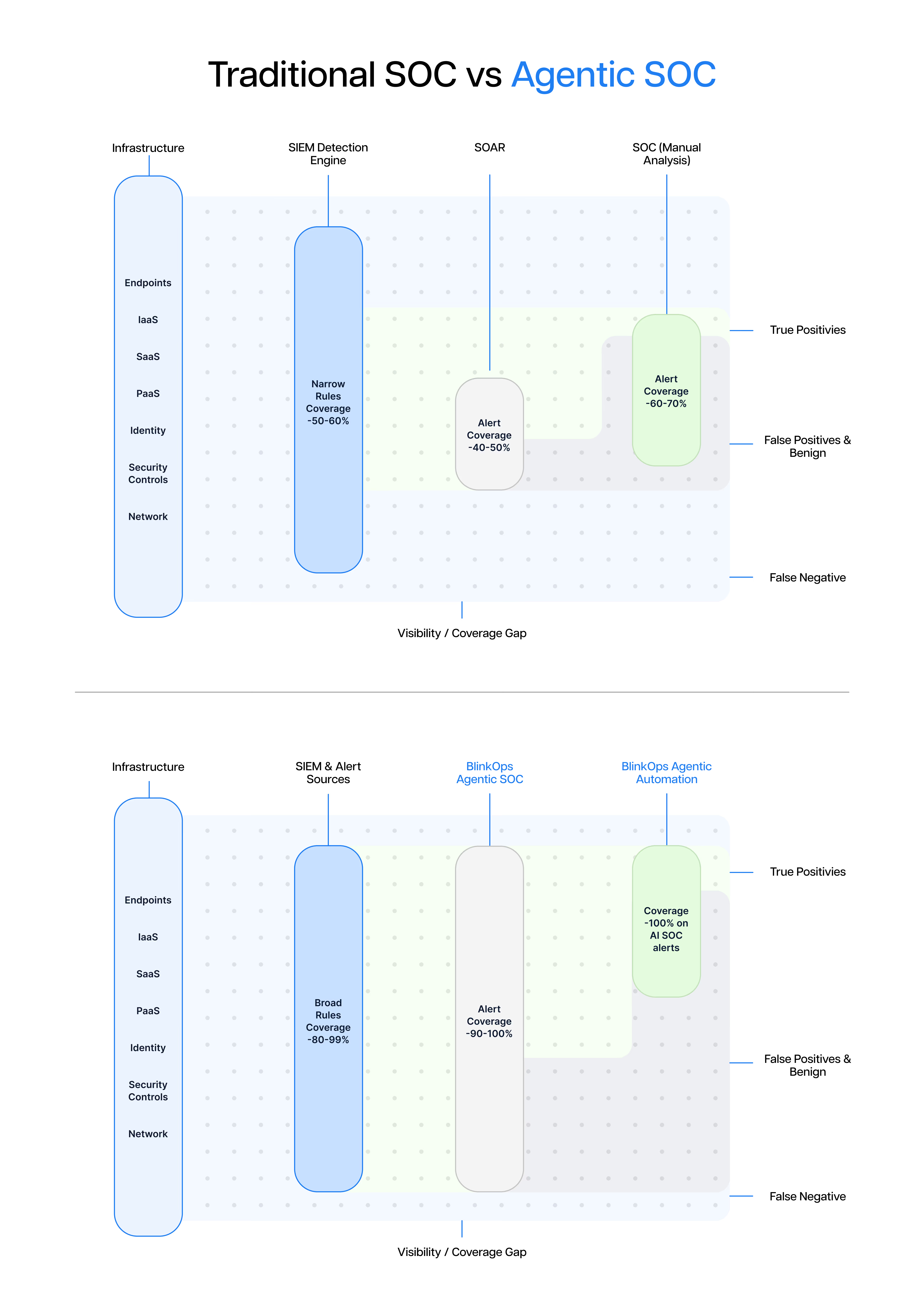
As your company grows, infrastructure grows with it. More cloud workloads, more SaaS apps, more identities, more APIs. Every new system means another tool to monitor, more detections, more alerts. This growth is exponential. Your team's growth? Linear at best. Flat in most cases.
SOAR helped with the middle of the workflow. It was good at enrichment and response. Once a human decided "this alert is worth investigating," SOAR could enrich the IOCs, pull context from five tools, and execute containment. That was real value.
But SOAR couldn't do triage. It couldn't look at an alert and reason: is this real? Is this noise? What should I check next? Threats change daily. The phishing playbook you built last week doesn't catch the technique showing up this week. You need agentic workflows that adapt as threats change, not static logic that requires an engineer to rewrite every time the adversary pivots.
Now here's the part that really matters for you as a technical leader. A bunch of AI SOC vendors showed up and said, "We'll handle triage." Some do it well. But they push the bottleneck from triage to response. The AI triaged 1,000 alerts. Who acts on the 200 that need containment? "Oh, for that you'll need your SOAR."
So now you're maintaining two platforms. Same integration tax. Same vendor management overhead. The bottleneck just moved downstream. You need a platform that handles the full lifecycle end to end: triage, investigation, response, and case management.
Before you rip anything out, take stock. I've seen too many teams jump to a new platform because the old one frustrated them, only to recreate the same problems in a new UI.
Here's the fundamental shift in thinking. With SOAR, the unit of work was a playbook. A flowchart that does one thing. Enrich this IOC. Isolate this host. Create this ticket. You'd string 10 playbooks together with sub-playbooks and hope nothing broke. When it did (and it always did), you'd spend a day debugging which step in which sub-playbook failed because some vendor changed a JSON field name.
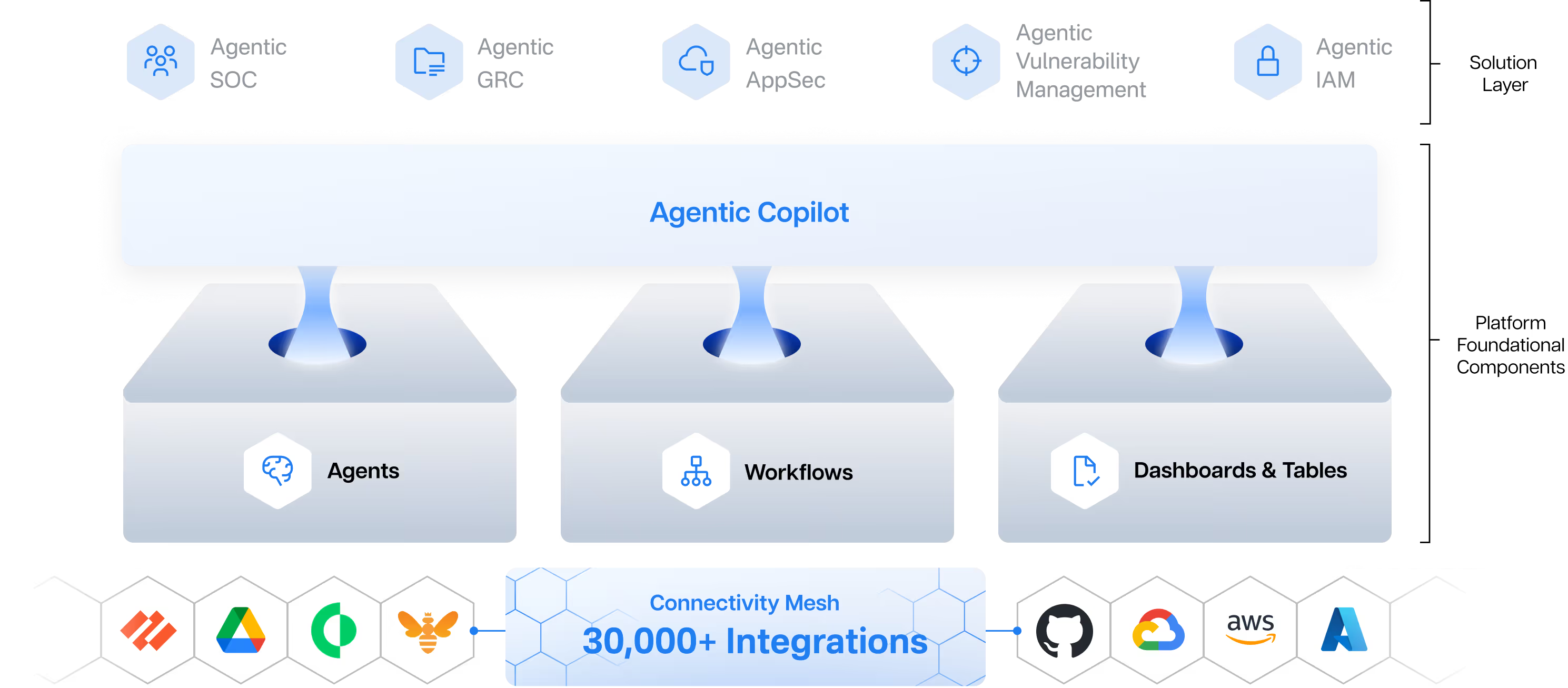
With an agentic platform, the unit of work isn't a playbook. It's a solution. A dedicated, purpose-built capability that handles an entire security function end to end. Not "a playbook that enriches a phishing IOC" but "a Phishing Triage solution that receives the alert, investigates it, makes a decision, and executes response."
Think about what your team actually needs to do every day:
.avif)
The key difference: these aren't playbooks you stitch together. They're dedicated solutions you can deploy plug-and-play or customize to your environment. You pick what you need. Agentic SOC is usually the starting point because that's where the pain is sharpest. But your cloud security team, your identity team, your GRC team, they all build on the same platform. Same integrations. Same skills. No more silos.
This is the flexibility question that every SOC manager and engineering lead needs answered: do I have to build everything from scratch, or can I get started fast?
The answer should be both. And that's where most platforms fail. SOAR was all "build it yourself." AI SOC vendors are all "use our black box." You need a platform that gives you:
This is the difference between a tool and a platform. A tool does one thing. A platform lets you build whatever you need.
Let me break down the key components you should expect from an agentic platform. If a vendor is missing any of these, you'll end up bolting on another tool to fill the gap (which defeats the whole purpose).
.avif)
When these six components live on one platform, you stop duct-taping tools together. The agent in Agentic Studio investigates an alert, writes its findings to Tables, triggers a response workflow in Workflow Studio, creates a case in Case Management, and the whole thing shows up on your Dashboard. One platform. One data model. One integration layer.
One of the first questions I get from SOC managers evaluating agentic platforms: "How do I trust an AI agent to make decisions in my environment?" Fair question. And the answer is guardrails. But not one layer. Two.
Layer 1: Reasoning Guardrails (Constraints)
This controls how the agent thinks. You define constraints that shape the agent's reasoning and decision-making. For example: "Only escalate to a human if the alert involves a critical asset." Or: "Never classify an alert as false positive if the source IP has appeared in threat intel in the last 30 days." These constraints guide the agent's logic before it ever takes an action. Think of it as the policies you'd give a new analyst on their first day, except these are enforced consistently, every time, at machine speed.
Layer 2: Execution Guardrails (Abilities)
This controls what the agent can actually do. You define the agent's abilities: which tools it can access, what actions it's allowed to perform, and where it needs human approval before executing. An agent might have the ability to query your SIEM and enrich IOCs, but not the ability to isolate a host without analyst approval. You scope the blast radius. The agent can reason all it wants about what should happen, but it can only execute within the boundaries you set.
Constraints shape how it thinks. Abilities shape what it does. Together, you get agents that are both smart and controlled.
And every action is auditable. Every reasoning step, every tool query, every decision, every action the agent takes is logged and visible. Your analysts can see exactly why the agent reached a conclusion and what it did about it. No black boxes. No "the AI said so" without receipts. If you're in a regulated environment and need to prove what happened during an incident, the full audit trail is there. This isn't optional transparency. It's built into the architecture.
This is the part most teams worry about. "We have 150 playbooks in our SOAR. Are we starting from zero?"
No. And this is important. A good agentic platform should let you bring your existing playbook logic with you. Your deterministic workflows (the ones that actually work well) don't need to become agentic. Containment actions, ticket creation, notification workflows, these are deterministic by nature. They should stay deterministic. What changes is what triggers them and what reasoning happens before they run.
Blink built proprietary migration tooling that transforms your existing deterministic playbooks into workflows on the platform. You're not rewriting from scratch. You're bringing your working automation and layering agentic reasoning on top.
Here's how I'd approach the migration phased:
At each phase: measure. Track investigation time, false positive rates, analyst hours saved, and playbook failure rates versus your old SOAR. Let the data tell the story.
With SOAR, you needed dedicated automation engineers who could build and maintain complex playbooks. Specialized skill, scarce talent. With an agentic platform, the build model shifts:
Your team stops spending time on playbook maintenance and starts spending time on detection engineering, threat hunting, and improving security posture. The triage grind gets handled by agents. Humans focus on work that requires human judgment.
But don't skip the people side. Train your team on working with AI agents. Teach them to review agent outputs, provide feedback, tune guardrails, and supervise agent behavior. The role evolves from "alert clicker" to "agent supervisor and detection engineer." That's a career upgrade, not a job cut.
I work at BlinkOps, so yes, I'm biased. But here's why I think this platform gets it right for teams doing this migration.
BlinkOps is an ASOP: Agentic Security Operations Platform. All six components I described above (Agentic Studio, Workflow Studio, Dashboard Studio, Tables, Case Management, Integration Engine) live on one platform. Agents and automations share the same data layer, the same integrations, and the same case management. No handoffs between tools.
You can start with a plug-and-play Agentic SOC solution and have it running in days. Or you can build custom solutions from scratch for whatever your team needs. Threat hunting. Detection engineering. Cloud security posture. Identity governance. It's your choice, and you can do both on the same platform.
The migration tooling converts your existing deterministic playbooks into Blink workflows. You're not starting from zero. You're bringing what works and adding the reasoning layer that SOAR never had. Teams deploy 30 workflows in the first month. Investigation time drops from hours to about a minute.
And pricing is per usage with the full platform included. No per-seat tax. No capability modules to unlock. Your whole team gets access from day one.
Migrating from SOAR isn't about throwing away what you built. Your playbook logic, your integration knowledge, your understanding of your environment, all of that transfers. What changes is the execution model and the scope of what's possible.
SOAR gave you playbooks. An agentic platform gives you solutions: Triage, Threat Hunting, Detection Engineering, Malware Analysis, Remediation, and whatever else your team needs. Some plug-and-play, some custom-built. All on one platform that handles the full lifecycle instead of pushing the bottleneck from one phase to another.
Start with one painful use case. Bring your existing playbooks. Layer agents on top. Measure the results. Expand when you're ready.
The SOAR era taught us that automation matters. The agentic era teaches us that reasoning matters more. Combine both on one platform, and you stop chasing the bottleneck and start eliminating it.
Q: Can I bring my existing SOAR playbooks? Yes. Blink has proprietary migration tooling that converts deterministic playbooks into platform workflows. You're not starting from zero. Bring what works, layer agentic reasoning on top.
Q: Do I have to go all-in on AI agents? No. Deterministic workflows and agentic workflows coexist on the same platform. Containment and remediation should stay deterministic with guardrails. Triage and investigation are where agents add the most value.
Q: How do I control what the agent can do? Two layers. Reasoning guardrails (constraints) control how the agent thinks and makes decisions. Execution guardrails (abilities) control which tools it can access and what actions require human approval. You set the blast radius.
Q: Is the agent's reasoning auditable? Every reasoning step, tool query, decision, and action is logged. Full audit trail. No black boxes. Analysts can see exactly why the agent reached a conclusion. Built for regulated environments.
Q: What if I just need plug-and-play for now? Deploy Agentic SOC out of the box and have it running in days. When you're ready for custom solutions (threat hunting, detection engineering, cloud security), you build on the same platform with the same integrations.
Q: What build options are available? Three modes on the same platform. Full code for your senior engineers. No-code drag-and-drop for SOC analysts. Natural language copilot builder for anyone. All produce the same result.
Q: What about integrations? 30,000+ connectors. When a vendor updates their API, the platform handles it. Your engineer doesn't get paged at 3 AM because a JSON schema changed.
Blink is secure, decentralized, and cloud-native. Get modern cloud and security operations today.