.webp)
.webp)

What Is an Agentic Security Operations Platform (ASOP)?
An ASOP is the control plane that runs AI agents and workflows from signal to resolution across every security domain. How it differs from AI SOC and SOAR.

See how BlinkOps can work for your security team.
An ASOP is the control plane that runs AI agents and workflows from signal to resolution across every security domain. How it differs from AI SOC and SOAR.


_%20A%20Guide%20for%20SecOps%20Leaders.jpg)
How ASOP differs from AI SOC and Agentic SOC, why it sits on the control plane, and how you keep control of it.
An Agentic Security Operations Platform (ASOP) is the control plane that runs AI agents and deterministic workflows to carry security work from signal to resolution. It works across every security domain, not just the SOC. Humans set the autonomy level per use case, and a platform-enforced harness keeps control below the model. It is a control plane, not a data plane, so it does not try to replace your SIEM.
In Why AI SOC Is Becoming a Feature, Not a Category, we made the case that AI SOC commoditized in about three years. Any vendor holding alert data can add autonomous triage. Dozens did. Triage got fast, the queue changed shape, and the bottleneck moved from detection to decision.
So what comes after a feature? A platform.
That post ended with a promise: the buyer’s version, how to evaluate a platform that closes the loop. This is it. What Agentic Security Operations (ASO) is, what an Agentic Security Operations Platform (ASOP) does, where it sits compared to AI SOC and Agentic SOC, and what to check before you buy one.
Written for the person who runs the program. If you own coverage, response, and a headcount line that doesn’t move, this is for you.
Agentic Security Operations is an operating model where AI agents and deterministic workflows carry security work from signal to resolution. Not only SOC alerts. Identity requests, vulnerability findings, compliance evidence, cloud misconfigurations. Anything that today lands in a queue a human has to work.
Humans set the autonomy level and stay in control.
The platform that runs this is the Agentic Security Operations Platform. It is the control plane for security work. It holds the integrations, the workflows, the agents, the cases, and the governance around all of it.
An AI agent is software that looks at what’s in front of it, reasons toward a goal, and acts through tools you approved. A workflow runs the same steps every time. An agent picks its next step based on what it just found. You need both. And you need something enforcing where each one is allowed to go.
Picture the SecOps spectrum left to right.
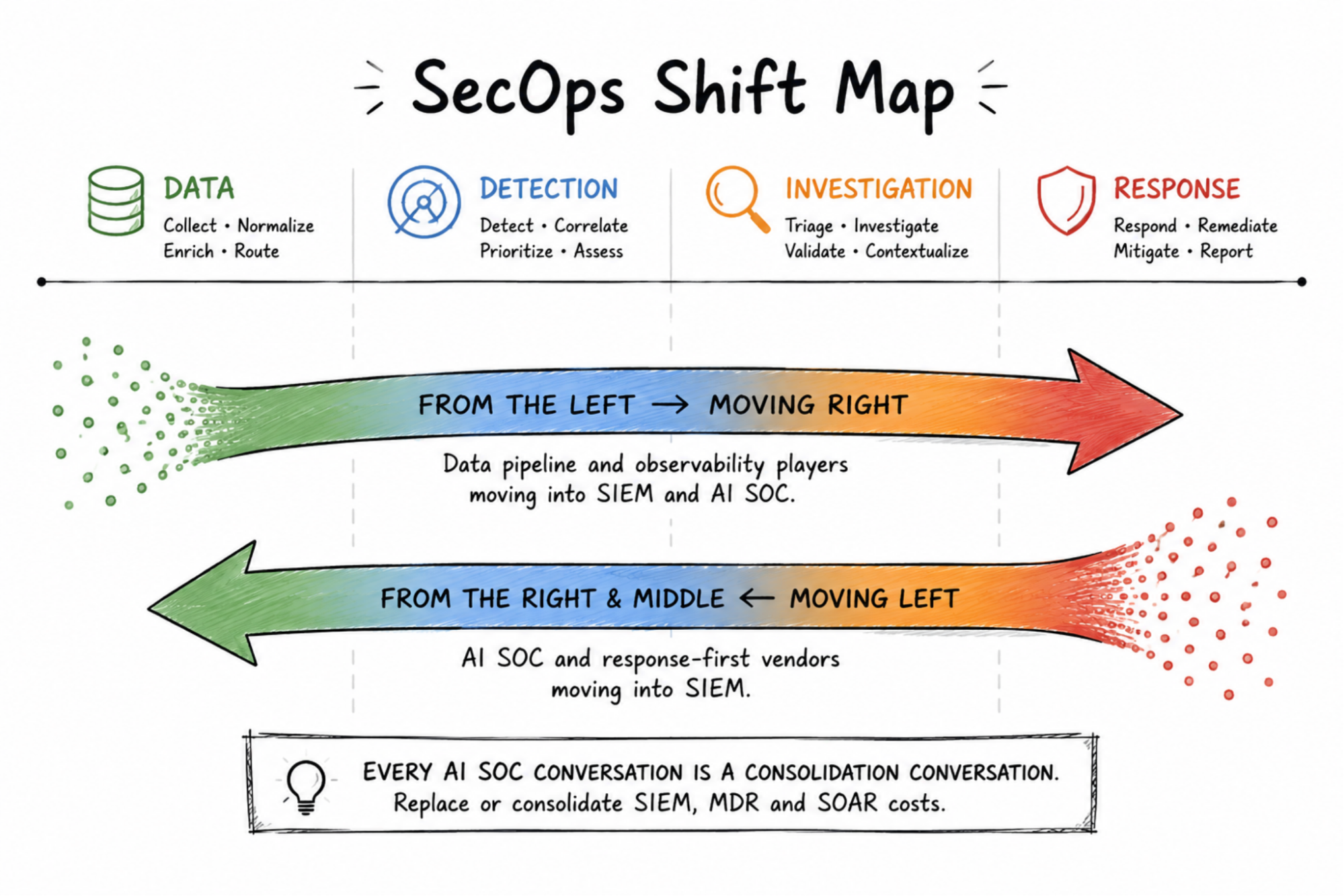
AI SOC, or whatever the market calls it this quarter (Agentic SOC, SOC AI, autonomous SOC), covers the middle. It reads alert data, reasons over it, and hands you a verdict. It needs no write access. That’s why it was quick to build, why everyone built it, and why it stops where it stops. A verdict engine with remediation left manual gives you faster alert closure and the same backlog.
[Visual: scope bar, SIEM + AI SOC]
ASO owns the middle and the right. Everything that happens after an alert fires, through to the fix.
It also reaches left, into detection engineering. Not to run detections. That job stays with whatever fires the alert: the SIEM, the EDR, the cloud security tool. The work around detections is a different thing. Tuning rules that fire on noise, finding coverage gaps, testing that a detection still works after the environment changed, and feeding investigation outcomes back into the rule. That is operational work, and you can build agentic solutions for it the same way you build them for triage or response. A detection that fired 847 times last month and auto-closed 812 as benign is telling you something. The system holding that outcome data is the one that can act on it.
[Visual: scope bar, SIEM + ASO. Extend the ASO bar into detection engineering on the left; the detection engine itself stays under SIEM]
What ASO does not do is the far left. Ingestion, parsing, normalization, storage, and the detection engine that runs rules over the data. That is data infrastructure. A platform that tries to own that as well is building a SIEM. Different bet.
Tools that only see cannot act. Tools that only act cannot reason. Tools that only reason are brains without hands.
The past decade followed data gravity. Centralize telemetry, gain visibility, generate insight. It worked until data outgrew the capacity to analyze it.
The next decade follows workflow gravity. Own the remediation workflow, own the outcome. Visibility without action is expensive monitoring.
This is also why AI triage did not shrink the workload. It moved it. Before AI, the queue was capped by human capacity, so low-severity alerts got suppressed and whole detection categories stayed off. AI removes the cap. Volume goes up on purpose, and a small escalation rate on ten times the volume is several times the human decisions you had before. The machine absorbed the processing. It did not absorb the judgment. We named the new constraint in the previous post: Mean Time to Decision.
A decision queue only clears when something takes the action. That something is the control plane.
This is the part that makes ASO a platform and not a rebranded SOC tool.
Look at what every agentic security solution needs: integrations with write access, orchestration, case tracking, a way for humans to approve and collaborate, governance and audit. AI SOC needs it. Agentic vulnerability management needs it. Agentic IAM, agentic cloud security, agentic GRC, agentic AppSec, agentic threat hunting, agentic detection engineering. Same substrate every time.
Buy them separately and you rebuild the same infrastructure five times. Five audit trails, five approval flows, five things your compliance team gets to learn. Run them on one ASOP and the context compounds. Asset, exposure, identity, case history, all in one place, feeding every agent.
That is what agentifying security work means in practice. Not an agent on every task. One control plane where any security workflow gets an agent when reasoning is needed and a deterministic workflow when it isn’t.
Blink runs on the SUDA loop: See, Understand, Decide, Act. Governance and human-in-the-loop control around every step.
[Visual: SUDA stages with deterministic / hybrid / frontier composition bar]
Each stage runs on the cheapest execution tier that solves it. A lookup runs deterministic. A judgment call gets a model. Running a frontier model on every alert is neither reliable nor affordable, and it turns your token bill into the new SIEM license.
Agents reason. Workflows execute. The harness enforces.
Distrust is the right default. Don’t trust AI SOC. Verify it.
Most of the category puts one frontier model in charge of triage, verdicts, and response, with bounds that live in a prompt. A guardrail is a prompt-level instruction asking the model to behave, so it can be misread, ignored, or talked around. A harness is a platform-level limit the agent cannot see, negotiate, or reason around: scoped tools, isolated execution, resource limits, circuit breakers. It runs below the model, where prompt injection can’t reach. The difference is that a guardrail only requests good behavior, while a harness binds it.
Blink backs this with four trust layers you can verify instead of taking the category on faith. We covered them in detail in the feature-not-category post; the short version:
Regulators are catching up. CISA’s agentic AI guidance, issued with allied agencies, recommends a secure-by-design approach and treating an agent as an untrusted identity with least privilege. Practical version: plan agent identity and a full audit trail before you widen autonomy, not after. Most organizations aren’t there. A 2026 Cloud Security Alliance identity survey found only 18% are highly confident their IAM can manage agent identities.
If your SOC still reports alerts closed per analyst per shift, you’re measuring a process that no longer exists.
The metric moves from Alerts Triaged to Autonomous and Human-on-the-loop Resolutions. The question changes from how many alerts did we close to how many issues did we actually fix. Uncomfortable, because it exposes the gap. Also the only metric that connects security operations spend to a security outcome.
Adoption is a maturity path, not a switch. Manual, then automated, then AI-assisted, then agent-led with approval, then autonomous under a harness. Trust is earned, not granted.
Start where triage load is highest and expand as trust builds. Then take the same platform to the next domain. The integrations, the case management, the approval flows, the audit trail are already there. That’s the point of doing it on a platform.
This is a people, process, and technology shift, not a purchase.
Judge on control and coverage, not the feature checklist.
Blink is BlinkOps’s Agentic Security Operations Platform: one platform to build, run, and control agents and workflows across your security stack. Blink AI SOC is one solution on it, next to agentic IAM, vulnerability management, AppSec, GRC, and threat hunting. Deterministic workflows and reasoning agents run together inside a platform-enforced harness. High-risk decisions stay human-in-the-loop and auditable.
With 30,000+ integrations and 500+ pre-built agent templates, Blink stays vendor-neutral and deploys in days. BlinkOps, backed by over $100M in funding, pairs the platform with embedded automation experts who help design and maintain the agents so the program keeps improving.
The results show up on the right side of the loop. HUMAN Security ran a threat-hunting agent 123 times, 11 needed human review, 2 were real findings requiring patching, and the agent took over 100 hours of manual work off the team. A global insurer went from 5 to 30+ agentic workflows and cut alert resolution from about 15 minutes to under one minute.
Blink is a force multiplier for the team you already have, not a replacement for it. Nobody starts from zero. And nobody should stop at the verdict.
An AI SOC applies agents to the middle of the loop: investigate alerts and reach a verdict. An ASOP is the control plane that carries work from signal to resolution and runs across every security domain, not only the SOC.
An agentic SOC, also called an AI SOC, is the SOC use case where AI agents triage, investigate, and help respond within human-defined bounds. It is one solution that runs on an ASOP.
No. Agentic SOC is the SOC use case. Agentic Security Operations is the model, and the platform behind it also runs IAM, vulnerability management, GRC, AppSec, and threat hunting on the same infrastructure.
SOAR executes the playbooks you built and cannot make a judgment call. An ASOP adds bounded reasoning, ships pre-built solutions you customize, and owns the feedback loop back into detection.
No. The SIEM stays the data layer and the detection engine. An ASOP takes everything after the alert fires, plus the engineering work around detections: tuning, coverage, validation, and feedback.
No. Agents and workflows take the repetitive processing. Analysts move to detection engineering, threat hunting, and deciding where the machine stops.
Trust comes from control, not the model. Expect a harness enforced below the model, human approval on high-risk actions, and an audit trail on every step.
Blink is secure, decentralized, and cloud-native. Get modern cloud and security operations today.