Security teams are being asked to hand more and more real work over to AI, not just alerts and dashboards, but actual investigation and response actions inside their environments. That shift raises a fundamental question for every CISO evaluating an AI SOC vendor: How do we know this AI is governed responsibly?
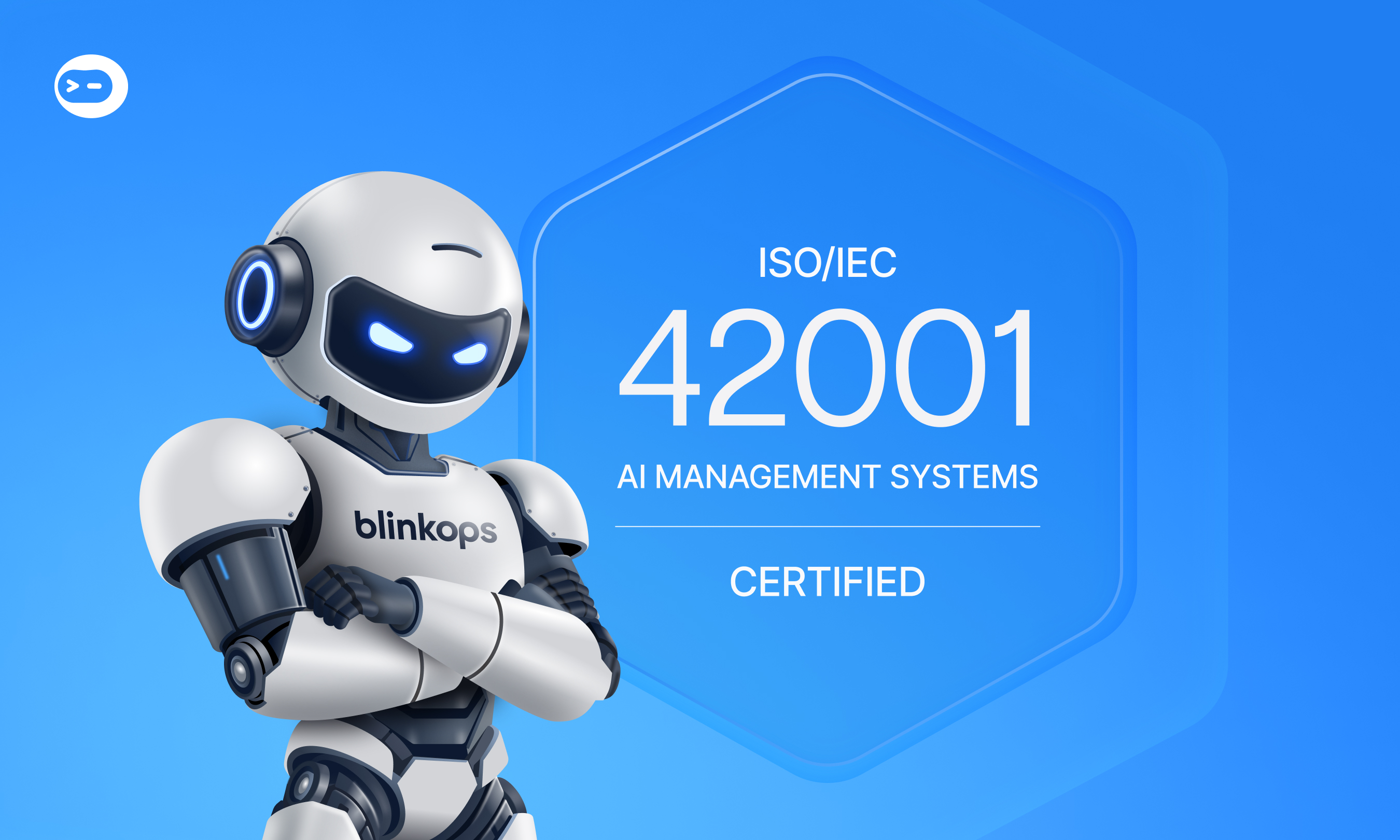
We are proud to share that BlinkOps has officially achieved ISO/IEC 42001:2023 certification, the world's first international standard for AI management systems (AIMS). The certification provides independent, third-party validation that BlinkOps has established and operates a formal system for governing AI across its lifecycle, including risk management, transparency, AI lifecycle governance, and human oversight.
The certification is based on a formal audit of how we govern and operate AI, giving our customers, prospects, and partners a verifiable answer to a question we hear often in security reviews and RFPs. We have always said Blink is built to give teams agents they can trust, rather than rogue frontier models bolted onto a security stack. ISO/IEC 42001 provides independent validation of the governance framework behind that approach.
What Is ISO/IEC 42001?
Published in December 2023, ISO/IEC 42001 is to AI governance what ISO/IEC 27001 is to information security: a structured management-system standard that organizations can be independently audited and certified against. Where ISO/IEC 27001 asks how you protect information, ISO/IEC 42001 asks how you govern AI throughout its lifecycle.
In practice, certification requires demonstrating controls across areas including:
- AI risk management: Identifying and mitigating risks specific to AI systems, including unintended behavior, bias, and failure modes.
- Transparency: Documenting how AI is used and establishing appropriate mechanisms for understanding AI-driven decisions and actions.
- AI lifecycle governance: Controlling how AI systems and features are developed, tested, updated, deployed, and retired.
- Human oversight: Ensuring people retain appropriate control over consequential AI-driven decisions and actions.
Because ISO/IEC 42001 is a management-system standard rather than a one-time assessment, it also requires ongoing monitoring and continual improvement. The goal is not simply to demonstrate that AI is governed today, but to establish a framework for maintaining that governance as AI capabilities evolve.
Why This Matters More in the AI SOC Category
AI governance matters everywhere. It matters even more when the AI in question can take action inside a customer's security stack.
Much of the AI used in the SOC today still summarizes, suggests, or drafts, and then a human decides what happens next. An agentic AI SOC is different. Blink's AI SOC runs a continuous See → Understand → Decide → Act loop: alerts are ingested and enriched, an investigation reaches a conclusion, and depending on how a team configures autonomy, a response action can execute without waiting on a human to initiate every step. That's a fundamentally different level of autonomy from a copilot that simply writes a summary.
The more autonomy an AI system has, the more important it becomes to understand what it can access, what it can do, and how its decisions can be reviewed: “What data can the AI access, and where does it go?” “Can we audit how it reached a conclusion?” “What guardrails prevent it from taking an action nobody approved? What happens when its behavior changes?”
That last question is particularly important when an agent is taking action on its own. An agent might safely auto-close low-severity alerts for months, until an update changes how it weighs a particular signal. It could then start closing cases that should be escalated, without any obvious system failure. Understanding and managing that kind of behavioral change is where ongoing AI governance becomes important.
Catching that kind of change requires a documented process for reviewing what changed, when, and why, both before and after it ships. That's where AI-specific governance becomes important.
This is why we deliberately built Blink around "agentic reasoning where it matters, structured logic everywhere else." Agentic reasoning brings judgment to the parts of an investigation that require it, while deterministic workflows keep everything else predictable and repeatable. Together, this hybrid approach gives security teams a practical path to greater autonomy without giving up control.
Although ISO/IEC 42001 doesn't necessarily answer every question on its own, it does provide evidence that a formal, audited management system is in place to consistently address AI-related risks and continually improve those controls. For security, risk, and procurement teams evaluating agentic AI, that kind of evidence is increasingly essential to building confidence and gaining approval to deploy AI in their environments.
Blink is Built for Trust
That balance between autonomy and control is reflected in how we build Blink. Blink enforces workspace-level permissions and task-level action controls, and lets teams set autonomy per agent and per action. A team can let an agent fully automate low-risk enrichment while requiring approval for anything that touches production.
Human approval before autonomous execution. Response Copilot can put a conversational approval step in front of remediation actions, so a human confirms what's about to happen before Blink acts. Teams can start fully human-reviewed and increase automation as confidence is earned.
Minimal trust by design. Agents don't get broad access to the environment. They get access to the specific tools and actions they need. Alert data, enrichment results, and playbook outputs are encrypted at rest and in transit, while credentials remain behind an isolated vault that only pre-approved actions can access. An agent can use a credential to do its job; it can't see or export it.
Every action is reviewable. Every action, reasoning step, and decision is logged, and investigations are reviewable end-to-end, so analysts and auditors can understand how the AI moved from an alert to a conclusion or action.
ISO/IEC 42001 gave us a formal framework to document and stress-test these practices as our AI capabilities evolve.
A Continued Commitment to Trust
The ISO/IEC 42001 certificate and badge are now live in the BlinkOps Trust Center, alongside our other compliance documentation. This certification is part of a broader collection of standards and certifications that demonstrate BlinkOps’ commitment to building a trusted platform. BlinkOps already maintains SOC 2 compliance, providing an established foundation of operational controls around security, confidentiality, access management, change management, incident response, and vendor risk management. ISO/IEC 42001 adds an AI-specific management framework for governing AI systems and their associated risks.
AI governance standards are still young, and we expect them to continue evolving alongside the technology itself. Achieving ISO/IEC 42001 is a milestone, not a finish line. We will continue investing in the controls, transparency, and oversight our customers expect as we expand what agentic AI can safely do inside the SOC.
The future of agentic AI isn't just about what AI can do. It's about whether teams can trust it to do it responsibly.
Don’t Trust AI SOC. Verify It.
The eight questions, the four trust layers, and the full investigation loop. Everything you need to put every vendor, including us, through the same test.
Download the Buyer's Guide →

.webp)
.webp)



%20V1%20(1).avif)
.avif)