Introducing BlinkOS: The Secure Operating System for Agentic Security Operations
Meet Blink Agentic Operators: a new kind of digital workforce, built to extend your security team with the reliability of deterministic automation and the intelligence of agentic reasoning.

TL;DR
- BlinkOps launches BlinkOS, the secure operating system purpose-built for agentic security operations. One AI layer, one context layer, and one action layer connect your entire security stack.
- AI-powered Operators handle security work across the SOC, identity, vulnerability management, cloud, AppSec, and GRC, within boundaries the team sets, with every step logged.
- It runs on the tools you already own, giving stretched security teams the capacity to catch up and more time for the work that needs their expertise. Available today.
Today, we’re introducing BlinkOS, the secure operating system for Agentic Security Operations, and Blink Agentic Operators, a fundamentally different approach to deploying agentic capabilities across the enterprise.
For the first time, security organizations can deploy an entire workforce of Agentic Operators that work alongside their people, take ownership of operational responsibilities, and execute work across their existing security stack.
And it’s possible because of the trusted foundation of BlinkOS.
Security teams don’t need more agents. They need an extended workforce.
The cybersecurity industry is entering the agentic era.
Attackers are moving faster, attack surfaces are expanding, and security teams are expected to protect increasingly complex environments without proportional increases in headcount.
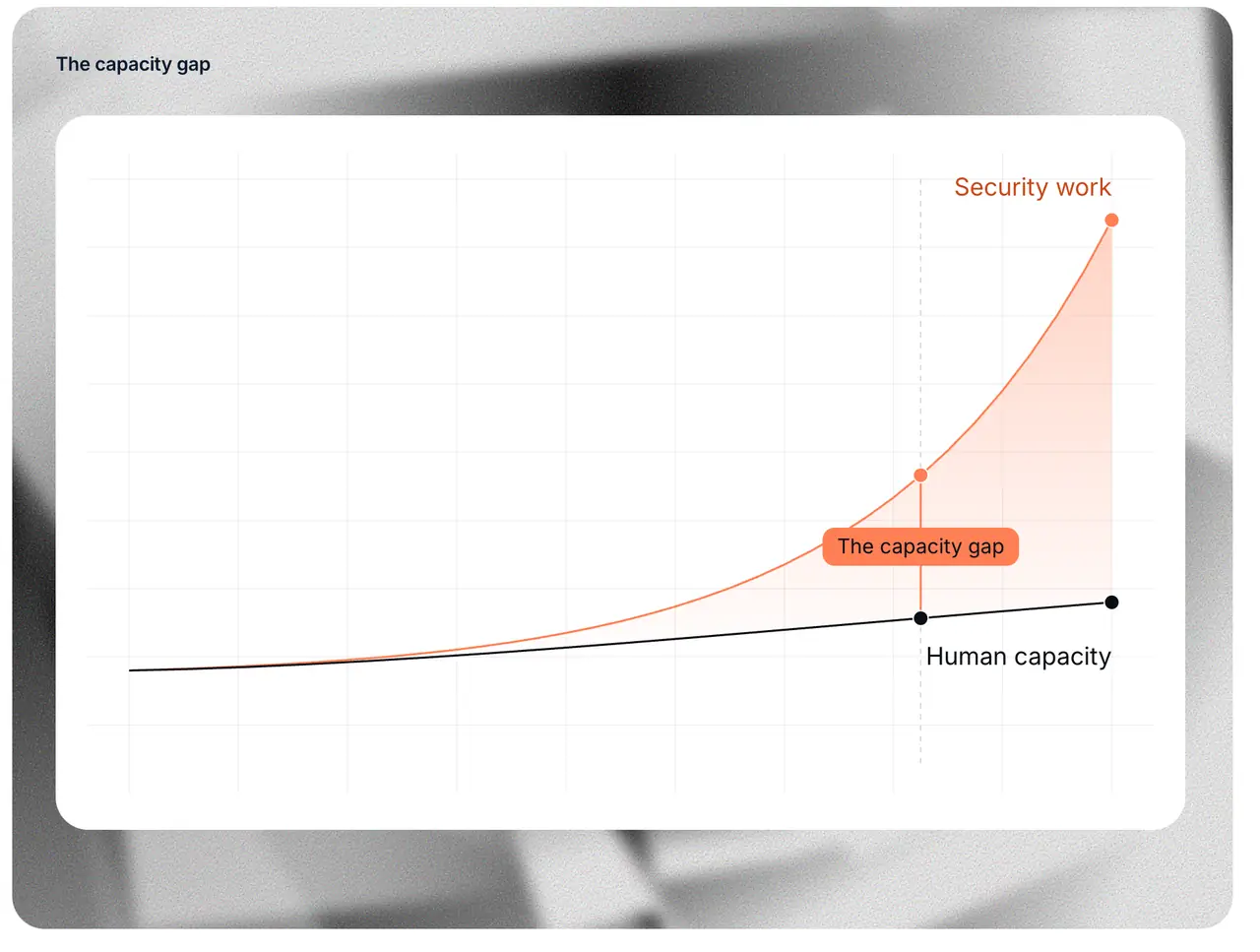
The natural response has been to introduce agents into security operations.
Today, nearly every security vendor is building agents into its products. Agents that investigate alerts. Agents that analyze vulnerabilities. Agents that recommend remediation.
But this creates two fundamental problems.
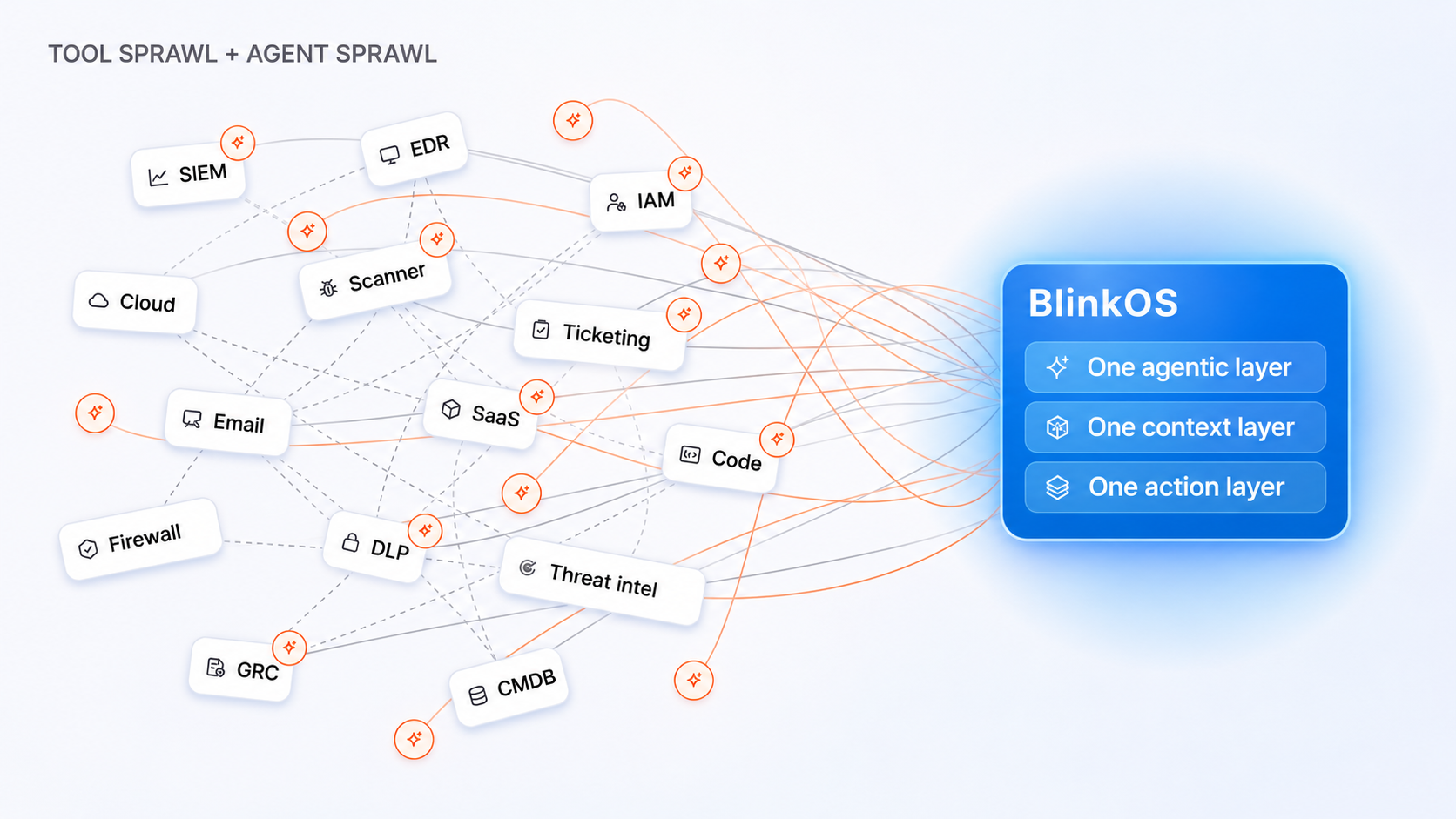
First, agent sprawl. Every security product introduces its own agents, context, permissions, and governance. Instead of eliminating silos, organizations are creating a new generation of them.
Second, and more importantly, trust. Most agents are built to reason first and execute second. They continuously determine their next steps, choose tools, and generate actions based on model decisions.
That approach can be useful for open-ended tasks. But security and IT operations are different.
When you’re responsible for mission-critical operations like isolating endpoints, revoking privileged access, modifying firewall policies, or remediating vulnerabilities, you need more than intelligent reasoning.
You need predictable execution, controlled permissions, consistent outcomes, and complete auditability.
Security teams cannot afford to trade operational reliability for agentic autonomy.
They need both. And that’s why we built BlinkOS and Blink Agentic Operators.
Introducing Blink Agentic Operators
A Blink Agentic Operator is a virtual security employee designed to take ownership of specific operational responsibilities and work as an extension of your existing team.
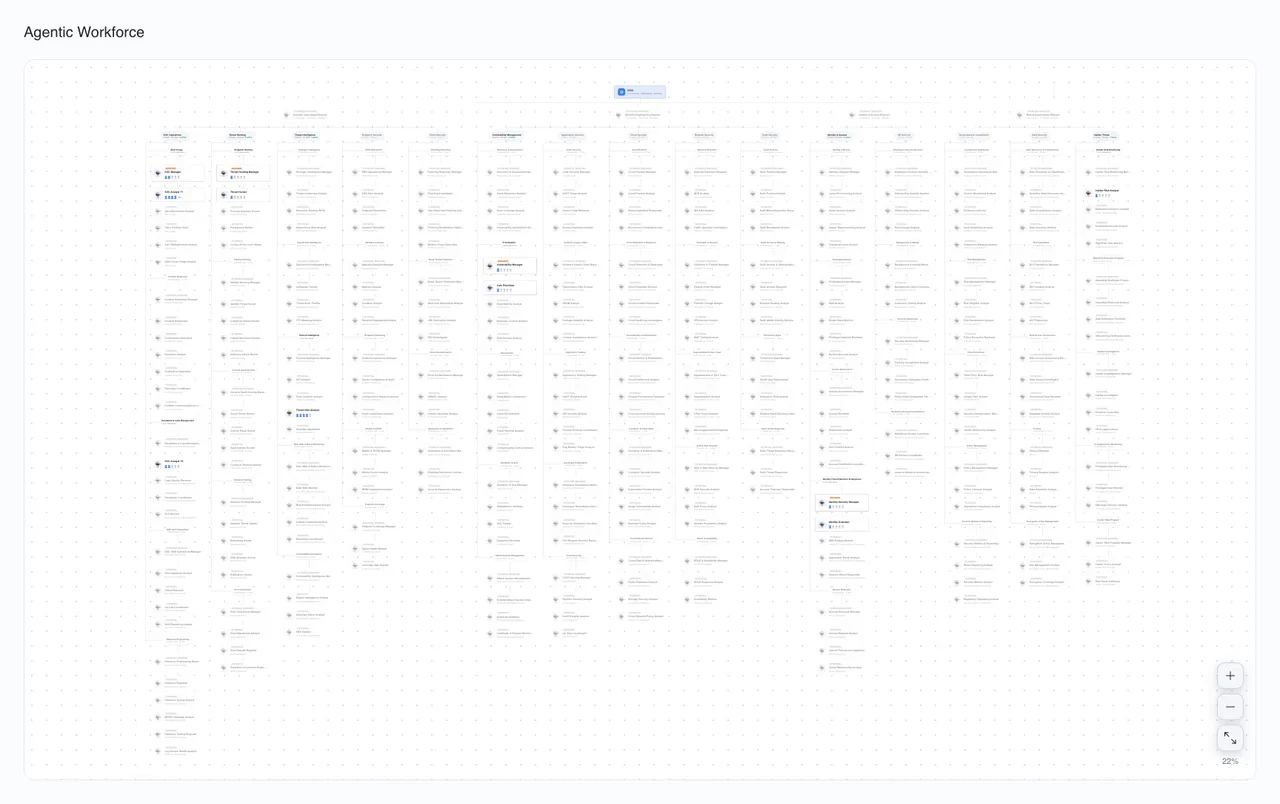
Like a human employee, an Operator has a defined role, responsibilities, capabilities, and boundaries.
An Operator can investigate security alerts, manage vulnerabilities, respond to incidents, provision identities, enforce policies, or coordinate complex operations across dozens of systems.
Unlike a conventional agent, however, an Operator doesn’t need to reason through every step of its work.
Operators are deterministic by default and agentic by exception.
That distinction changes everything.
Agents vs. Agentic Operators: A fundamentally different architecture
Traditional agents are generally agentic-first.
They start with a goal, use a model to reason about the next action, select tools, evaluate results, and continue reasoning until the task is complete. Deterministic tools and workflows may be used along the way, but the agent’s reasoning typically drives the execution process.
Blink Agentic Operators reverse this architecture.
They are deterministic-first.
An Operator follows predefined, governed workflows wherever the work can be reliably executed without reasoning. When it encounters a situation requiring interpretation, investigation, or judgment, it invokes specialized agentic capabilities to resolve that specific problem.
Once that reasoning is complete, execution continues through governed workflows.
The Operator doesn’t use reasoning to perform work that deterministic automation can already perform reliably.
Consider a security alert investigation.
A conventional agent might repeatedly reason about which tool to call, what information to retrieve, and what action to take next.
A Blink Operator can deterministically collect telemetry, enrich indicators, correlate events, and apply established detection logic. It invokes agentic reasoning only when the evidence requires deeper interpretation or an unfamiliar situation emerges.
The resulting actions still execute through approved workflows, with the appropriate permissions and human approvals.
The result is an entirely different operational model:
This architecture delivers four critical advantages.
- Reliability. Deterministic operations produce consistent, repeatable behavior rather than relying on a model to rediscover the same process every time.
- Speed. Operators execute routine work directly, without waiting for repeated model inference.
- Efficiency. Deterministic steps require no inference tokens. Agentic reasoning is reserved for the situations where it creates value, dramatically reducing unnecessary token consumption.
- Trust. Every action runs through controlled execution paths, with explicit permissions, approval policies, and audit trails.
This is what makes Agentic Operators suitable for production security and IT environments.
The intelligence of agents. The reliability of automation. The operational accountability of an employee.
BlinkOS: The secure foundation for an agentic workforce
Building a powerful Operator is only part of the challenge.
Enterprises need to deploy, connect, secure, govern, and scale entire workforces of Operators across their security infrastructure.
That’s why we built BlinkOS.
BlinkOS is the secure operating system purpose-built to run Agentic Operators across enterprise security operations.
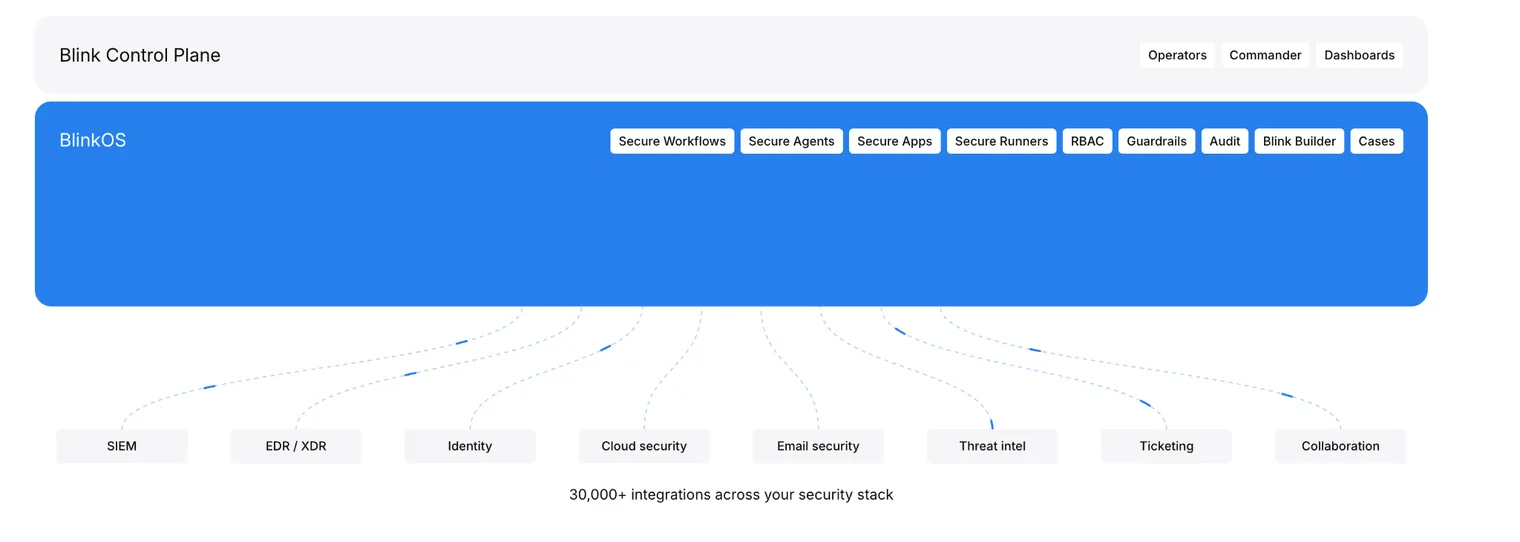
Rather than deploying disconnected agents inside individual security products, BlinkOS provides a common operating environment where Operators can share context, coordinate work, and securely execute actions across the entire technology stack.
At its core, BlinkOS unifies three foundational layers.
One agentic layer
A unified environment for specialized agentic reasoning across security operations.
Operators can invoke agentic capabilities when needed, drawing on frontier models, cybersecurity-specific models, and specialized agents without being tied to a single provider.
Instead of each security product operating its own isolated agent, BlinkOS provides a shared foundation for agentic intelligence.
One context layer
A shared context across your security tools, investigations, assets, identities, policies, and organizational knowledge.
Operators can work from a consistent understanding of the environment and coordinate across security functions.
An Operator investigating a suspicious identity can incorporate endpoint activity, cloud permissions, recent vulnerabilities, and previous incidents without treating every system as a separate universe.
One action layer
A secure, deterministic execution environment that turns decisions into governed actions.
Every action executes through controlled workflows with defined permissions, approval requirements, and complete auditability.
Agentic reasoning can determine what needs to happen. BlinkOS controls how it happens.
Together, these layers create a secure foundation for operating an agentic workforce across the enterprise.
BlinkOS connects to the technologies organizations already own through more than 30,000 pre-built integrations across cloud, SaaS, security, and on-premises environments.
It also supports frontier and cybersecurity-specific models. For example, organizations granted access to Mythos through Anthropic’s Cyber Verification Program can bring those capabilities into BlinkOS and operationalize them through governed security workflows.
No rip-and-replace. No isolated agent infrastructure for every security tool.
One operating system. One shared context. One governed execution environment.
Built for trust: Agentic reasoning never means unrestricted execution
For agentic technology to become part of critical security infrastructure, trust cannot depend on a prompt or a model’s willingness to follow instructions.
It must be enforced by the architecture.
BlinkOS separates reasoning from execution through four foundational capabilities.
1. Deterministic workflows
Security operations execute through predefined, governed workflows wherever possible.
Instead of allowing agents to freely generate and execute commands, BlinkOS provides controlled execution paths that can be inspected, tested, customized, and audited.
Agentic reasoning is introduced only when necessary, without bypassing the execution controls.
2. Secure, specialized agents
BlinkOS uses specialized agents with narrowly scoped responsibilities rather than relying on unrestricted, monolithic agents.
These agents provide reasoning and intelligence within defined boundaries.
They interact with enterprise systems through approved capabilities, without direct access to credentials.
3. Secure runners
Actions execute through isolated secure runners, either managed by BlinkOps or deployed within customer-controlled infrastructure, including private cloud and on-premises environments.
This allows sensitive credentials and execution to remain inside the appropriate security boundary.
Models reason. Secure runners execute.
4. Enterprise governance and auditability
BlinkOS provides centralized controls for least-privilege access, tenant isolation, human-in-the-loop approvals, and comprehensive audit trails.
Security teams define what Operators are allowed to do, what requires human approval, and how actions are recorded.
The goal isn’t to remove human control.
It’s to give security teams the ability to delegate operational work without delegating away accountability.
Beyond the SOC: An unlimited workforce of Agentic Operators
Much of the industry’s agentic innovation has focused on the Security Operations Center.
But the SOC is only one part of the security organization.
Security operations also span identity, vulnerability management, cloud security, application security, incident response, and governance, risk, and compliance.
And the work doesn’t stop at the boundaries between these teams.
BlinkOS is designed to support Agentic Operators across the entire security organization.
With BlinkOps, enterprises can deploy an unlimited number of Operators, customize them to their specific environment, and create entirely new operational roles.
Examples include:
- SOC Operators that triage alerts, investigate threats, correlate evidence, and coordinate incident response.
- Threat Hunting Operators that continuously investigate suspicious behavior across endpoints, identities, and cloud environments.
- Vulnerability Management Operators that prioritize exposure, coordinate remediation, and verify fixes.
- Identity Security Operators that manage access changes, investigate identity threats, and enforce least-privilege policies.
- Cloud Security Operators that investigate misconfigurations, validate exposure, and coordinate remediation.
- Application Security Operators that correlate findings, identify ownership, and coordinate fixes with development teams.
- GRC Operators that continuously collect evidence, validate controls, and prepare compliance reporting.
Each Operator can be tailored to the organization’s tools, processes, policies, and approval requirements.
And because Operators share the same BlinkOS foundation, they can coordinate work across domains rather than creating another collection of disconnected automations.
Imagine a vulnerability Operator identifying an exposed critical asset, coordinating with a cloud security Operator to assess the exposure, and triggering a remediation workflow after receiving the required approval.
Or a SOC Operator investigating a compromised identity and coordinating with an identity Operator to revoke access across connected systems.
One workforce, working across your entire security program.
The Blink Platform: Build, deploy, and manage your agentic workforce
BlinkOS provides the secure foundation.
The Blink Platform provides everything security teams need to put that foundation to work.
Blink Operators: Your agentic workforce
Choose from a growing library of hundreds of pre-built Operators designed by security practitioners.
Each Operator comes with a defined operational purpose and can be customized for your environment.
Need something unique? Use Blink Builder to create your own Operators, combining deterministic workflows, agentic reasoning, integrations, and organizational policies.
Deploy one Operator or an unlimited workforce across your security organization.
Blink Control Plane: One place to run your workforce
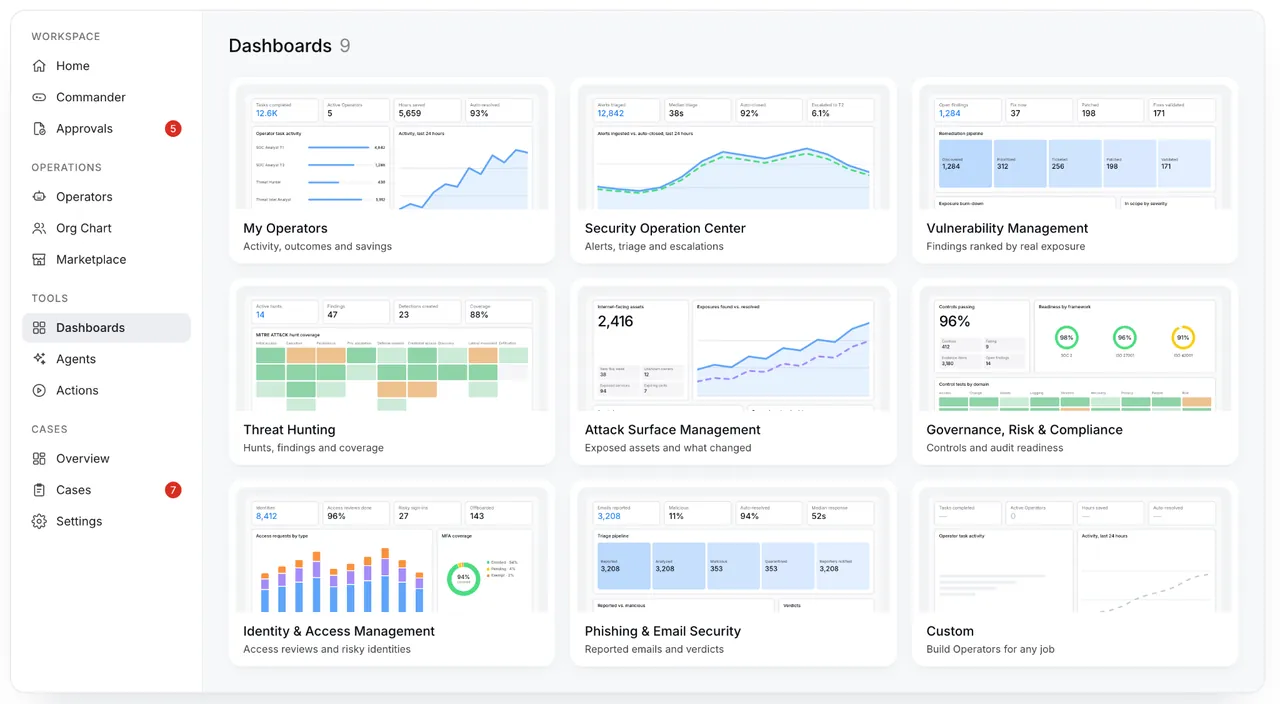
The Blink Control Plane provides a centralized environment to design, deploy, manage, monitor, and govern your Operators.
Security teams can manage operational responsibilities, coordinate investigations, oversee human approvals, review cases, and measure outcomes through unified dashboards.
Rather than managing isolated agents across dozens of security tools, teams gain one control plane for their entire agentic workforce.
Agentic Transformation Service: Let us do the work for you
Not every security organization wants to build and maintain its own Operators.
And they shouldn’t have to.
With our Agentic Transformation Service, our forward-deployed engineers work directly with your team to design, build, deploy, and continuously maintain your Agentic Operators.
Your team defines the outcomes, responsibilities, and boundaries.
Blink FDEs handle the engineering and ongoing evolution.
Whether you want to build your own workforce using the Blink Platform or have BlinkOps deliver and maintain it for you, the underlying foundation remains the same: BlinkOS.
Enterprise security by design
BlinkOS was designed for organizations where security, governance, and operational predictability are non-negotiable.
BlinkOps maintains SOC 2 Type II attestation, ISO 27001 certification, and ISO 42001 certification for AI management systems.
Customer environments are isolated, and customer data is never used to train AI models.
With controlled execution, credential isolation, least-privilege permissions, human approvals, and comprehensive auditability, BlinkOS enables enterprises to adopt agentic operations without sacrificing the controls their security teams require.
The future of security isn’t more agents. It’s Agentic Operators.
Security teams don’t need another collection of agents to manage.
They need the ability to scale their operational capacity, accelerate response, reduce risk, and accomplish more without continuously increasing headcount.
That requires a different approach to agentic technology.
One where intelligence is available everywhere, but reasoning is used deliberately.
Where deterministic execution is the default, not an afterthought.
Where Operators can take on meaningful responsibilities while remaining predictable, governed, and accountable.
That’s the difference between deploying agents and building an agentic workforce.
Today, with the launch of BlinkOS, we’re making that workforce possible.
BlinkOS is available today as the secure foundation of the Blink Platform.
Discover how BlinkOS can transform your security operations with an unlimited workforce of trusted Agentic Operators.

Frequently asked questions
What is BlinkOS?
BlinkOS is the secure operating system for Agentic Security Operations. It provides a unified agentic layer, shared context layer, and deterministic action layer for building, deploying, and governing Agentic Operators across enterprise security and IT environments. BlinkOS is the foundation of the Blink Platform.
What is a Blink Agentic Operator?
A Blink Agentic Operator is a virtual security employee that performs defined operational responsibilities as an extension of a security team.
Unlike conventional agents, Blink Operators are deterministic-first. They execute through reliable, governed workflows by default and invoke agentic reasoning only when needed.
Operators can be deployed from a library of pre-built roles, customized, or built from scratch using Blink Builder.
How are Agentic Operators different from traditional agents?
The fundamental difference is their architecture.
Traditional agents are agentic-first: reasoning drives their execution process, with deterministic tools used as needed.
Blink Agentic Operators are deterministic-first: governed workflows drive execution, and agentic reasoning is introduced only where necessary.
This approach provides greater predictability, faster routine execution, lower token consumption, and stronger operational control, making Operators particularly suitable for security and IT environments.
Are Blink Operators fully autonomous?
Operators can execute work autonomously within the boundaries defined by the security team.
Organizations determine which workflows run automatically, which decisions require human approval, and which actions are restricted.
Autonomy is governed by explicit policies and permissions, not left entirely to model discretion.
How is BlinkOS different from an AI SOC?
An AI SOC focuses primarily on security alert triage and investigation.
BlinkOS supports Agentic Operators across the entire security organization, including the SOC, incident response, vulnerability management, identity security, cloud security, application security, and GRC.
AI SOC is one use case within the broader Agentic Security Operations model enabled by BlinkOS.
Does BlinkOS replace existing security tools?
BlinkOS connects the technologies organizations already use through more than 30,000 pre-built integrations across cloud, SaaS, and on-premises environments.
Operators work across existing systems rather than requiring organizations to replace their security stack. BlinkOps can also replace legacy SOAR capabilities with a combination of deterministic workflows, agentic reasoning, and case management.
How does BlinkOS keep Agentic Operators secure?
BlinkOS separates agentic reasoning from action execution.
Actions run through governed workflows and secure runners. Specialized agents operate with scoped responsibilities and without direct access to credentials.
Least-privilege permissions, human-in-the-loop approvals, tenant isolation, and comprehensive audit trails provide centralized governance over Operator activity.
Can organizations build their own Operators?
Yes. Organizations can customize pre-built Operators or create entirely new ones using Blink Builder.
Operators can be designed around specific operational roles, existing workflows, security tools, approval policies, and business requirements.
Organizations can also use Blink Force, where BlinkOps forward-deployed engineers build, deploy, and continuously maintain Operators on their behalf.